Case 20 · Filed 26 November 2026 · Amends: “We had the most amazing time.”
Esther spent 11 days in Puglia and came home with 1,412 photographs, which is fortunate, because she has almost no memory of going. She remembers the airport. She remembers a row with Rob about a hire car in Bari. She remembers, very clearly, the comments.
The photographs are superb. You have probably seen some of them; you may have liked one. There is Esther on the white steps of a town above the sea, alone, in a linen dress the colour of a good biscuit, at an hour when the town is empty. It is empty because she set an alarm for 5am to photograph it before the other tourists arrived, which means she got up in the dark to take a picture of a place without people like her in it. There is Esther at a fortified farmhouse with a pool that seems to pour off the edge of the world. There is Esther at a long table under a lemon tree, laughing at something just out of frame. What was just out of frame was Rob, saying “one more” for the 40th time, holding the phone at hip height because she had read that it lengthens the legs.
The caption on the first of 31 posts said: Eleven days. No plans, no schedule. Just being presentstruck out: being present corrected to: being photographed.
What she remembers best about Puglia is the comments.
There is a version of events about Esther, and you already know it, because it is the version of events about almost everybody now. The phones did it. We used to live our lives and now we stage them; we used to have experiences and now we produce evidence of experiences, and somewhere between the two the experience slipped out by the back door. It is a persuasive account, and it isn’t only a mood. In 2014 a psychologist in Connecticut walked students round a university museum and asked them to photograph some objects and simply look at others. The next day they remembered less about the objects they had photographed. The camera, it seemed, had remembered on their behalf, and the brain, being no fool, had let it.
So the advice writes itself, and has been written many thousands of times: put the phone down. Be present. Some comedians lock your phone in a little pouch at the door, like a coat, so that you can enjoy the show without evidence. People announce they are leaving social media in posts that do very well on social media. The case against Esther is open and shut, and it is so satisfying to make that it is worth asking, before we make it, who exactly the photographs were for.
⁂
Take Marcus, who has spent more of the last four years proving he can afford a life than living one, and has the paperwork to show for it.
Marcus is 44 and sells scheduling software to dental practices, which pays better than it sounds and is about as interesting as it sounds, and he is very good at it. In 2021 he bought a Victorian terrace in Walthamstow at what turned out to be the top of the market, and he has been furnishing it for an audience ever since. Reconstruct the house and you reconstruct the arrangement. The kitchen island, a slab of quartz the size of a single bed, is on 0% finance over 36 months. The car outside is on a personal contract purchase, which means he pays £640 a month to drive a car that, at the end of four years, he can hand back or buy for a sum nobody in the household says out loud. In the garden there is a ceramic barbecue under a fitted cover, and beside it a hot tub, which Marcus has been in four times, all of them with guests. There is a tap that dispenses boiling water. He demonstrates it.
He works 60-hour weeks to pay for a house he is in, awake, for perhaps 30 hours of them, most of those on Saturdays, when people come round. The open shelves hold matching jars of things he doesn’t cook with. The cookbooks were chosen, Jen says, for their spines. Jen is his partner; she moves the kitchen roll out of shot before the food is photographed, and she knows where the real bin is, which is in a cupboard, so that the kitchen can appear to produce no rubbish.
This is the arrangement, and it isn’t complicated once you have the invoices. A performance has production costs, and Marcus pays them monthly. What he gets in return isn’t the house. He barely has time for the house. What he gets is the moment, at about 8pm on a Saturday, when somebody stands at the island with a glass of his wine, looks round, and says, “God, Marcus.” The house is the stage. The guests are the box office. Envy, carefully cultivated and gently exhaled, is what the whole thing runs on, and Marcus, like Esther, has quietly reorganised his life so that the part that is witnessed is paid for by the part that isn’t.
That’s the anatomy, and it is damning, and you have probably already thought of three people it describes. Hold on to them. We’ll need them later.
⁂
Here the version of events starts to wobble.
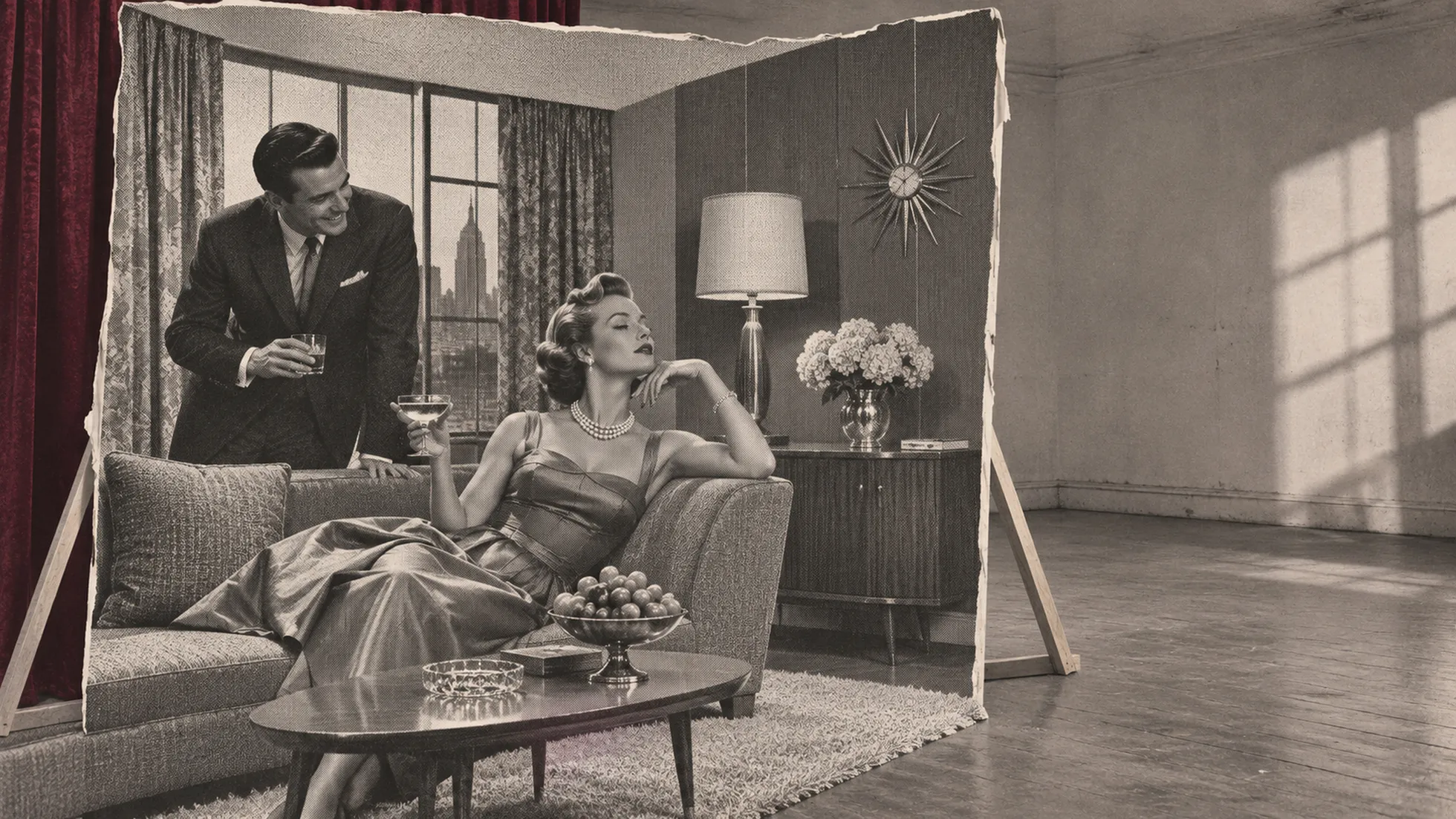
The first problem is that none of this is new. Your grandparents, or somebody’s, kept a front room that nobody sat in. It had the good settee and the good china and, in some houses, plastic covers on the good settee, so that it could be kept good for visitors who came twice a year and were never once allowed to sit on the plastic. Families went to a studio in their Sunday best to be photographed in front of a painted library they did not own. The albums were edited as ruthlessly as any feed: the one where somebody blinked went in a drawer; the one where your aunt had been crying went in the bin. The front room was a set. The phones didn’t invent the performance. They moved the front room into your pocket and let more people in.
The second problem is in the same museum study, further down, where fewer people read. When the students zoomed in to photograph a detail of an object, the forgetting went away; they remembered it about as well as the things they had only looked at. The camera wasn’t the thief. Inattention was. Esther, setting an alarm for 5am to catch the light on a white step, was paying more attention to that step than anyone else in Puglia. She just wasn’t paying attention to Puglia.
The third problem is Marcus himself, who is very easy to laugh at until you know where he started. He grew up in a two-bed flat above a launderette in Thornton Heath, with a father who drove buses for 31 years and believed that anybody with a kitchen island had taken it from somebody. Marcus did not inherit the deposit. He saved it, over a decade of evenings, and he built the career out of a temp job and a real talent for making dentists feel listened to. The house is not a con. It is a receipt. Every Saturday he lays it out for inspection because for most of his life nobody expected him to have anything to inspect, and some of the people who didn’t expect it are now standing at his island saying, “God, Marcus.” The first time his father visited, he looked at the island for a long time and asked what it had cost, and Marcus told him a figure about a third of the real one, which is the only performance in the house nobody has ever seen.
⁂
On a Saturday in October, you go to Marcus’s for dinner.
The invitation arrives in the group on the Tuesday. Saturday? Nothing fancy, just a few friendsstruck out: a few friends corrected to: an audience round for food. M x
You bring a bottle with a hand-drawn label from the wine shop by the station. Marcus thanks you warmly and puts it in a cupboard, which is the wine equivalent of being seated by the toilets, and opens something of his own that he has decanted, and tells you about the slope it grew on. Then the tour. You have never been given the tour of a kitchen you were then allowed to cook in. It starts in the hall, passes the downstairs loo with its expensive hand soap, and ends at the island, where Marcus stands with one palm flat on the quartz like a man about to swear an oath on it. He demonstrates the tap. Esther films him demonstrating the tap.
There are eight of you. Esther and Rob, tanned. Priya, who is thinking of leaving Instagram, and says so. Nadia and Sam, who spent the summer at home and say it was lovely. Jen. Marcus. You.
The lamb has been in the oven for seven hours. It comes out at 8.40 and is not eaten until 8.52, because Marcus wants it by the window while there’s light, and Jen stands behind him holding the kitchen roll behind her back like a hostage. By the time it reaches the table it is lukewarm and the best lamb you have eaten all year, which is annoying. That’s the trouble with Marcus: the performance is never quite empty.
Over pudding, Esther’s phone goes round. This is Puglia, a scroll in slow motion, and the table does what a table does. “Oh, wow.” “Is that real?” “Where is that?” Esther narrates, and you notice she narrates the photographs, not the trip: this one took 40 goes; the light in this one was impossible; they had to wait 20 minutes for a German family to get out of the pool in this one. Nobody asks what they ate. When the phone reaches you, you look at the pool that pours off the edge of the world, and you pinch the screen, quite casually, to enlarge a towel on a sunbed, where the name of the farmhouse is embroidered in small blue letters. You pass the phone on.
Priya says she’s leaving Instagram in the new year. Marcus says he’s barely on it. Jen looks at him for slightly longer than a look.
And it is then, into a lull, with a glass of Marcus’s wine in your hand and his lamb inside you, that you say it. You don’t plan to. It arrives the way the good lines do, fully formed, as if you have only just thought of it.
“When did everyone’s life become a performance?”
It gets the biggest laugh of the night. Nadia actually puts her glass down. Marcus laughs loudest, and raises his glass to you, and says, “Guilty,” which gets a second laugh, and Esther, still laughing, holds up her phone and photographs the table laughing at the line about performance, and nobody, including you, finds this strange until much later.
⁂
The evening ends at 11.30. The real evening starts at 11.47, on the Overground, in the group without Marcus in it.
You know the group. Most circles of friends have one: the same people as the main chat, minus whoever is being discussed, renamed something innocent. This one is called Book club. There has never been a book.
The reviews begin before the train leaves Walthamstow Central. Priya: the TAP. Sam: 36 months 0% I would bet my house on it. Nadia: did you see Jen’s face at “barely on it”. And you, because you’re good at this, because it is the thing you are best at, open a browser, type in the name from the towel, and post a screenshot. £380 a night. And she can’t remember a thing. It is, by some distance, the best part of the evening. It is the part you were looking forward to, though you didn’t know it, the way you don’t know you’re hungry until someone opens the crisps.
Then you open Instagram to look at Esther’s photograph of the table, and find yourself in it, mid-laugh at your own line, and look at your own face for longer than you looked at Puglia, and decide it’s a good one of you, and like it.
Then you write to Marcus. Thank you so much for tonight, it was so relaxedstruck out: so relaxed corrected to: thoroughly reviewed. That lamb.
Now go back over the evening, the way you went back over Marcus’s.
The bottle with the hand-drawn label cost £22. You chose it at 6.50pm with some care, because £22 with a hand-drawn label reads as taste and £22 with a gold one reads as effort, and you would rather be thought to have taste. When Marcus put it in the cupboard you minded, and you noticed yourself minding, and you minded that too. The line about performance wasn’t new. You first said it in March, at a different dinner, about different people, and it got the laugh there as well, which is why it arrived on Saturday so fully formed: it had been rehearsed. The zoom on the towel wasn’t curiosity. It was research, done in public with a straight face, for a review you already knew you would publish on the train.
You weren’t watching the show. You were in it. Earlier you thought of three people this essay describes. It is a safe bet that none of them was you. Your part is a good one, possibly the best: the one who sees through it. A dinner like Marcus’s has a host who stages the evening and, if it’s any good, a guest who quietly takes it apart, and the guest gets the laugh at the table and the second laugh on the train, and goes home with the most valuable thing anyone takes home from a Saturday, which is the sense of having been the only person there who wasn’t fooled.
“You thought you were the audience. You were the reviews.”
And the reviews, it turns out, are what the production is for. Marcus knows exactly what is said on the Overground. He doesn’t know the group’s name, but he knows there is a group, because he is in several, about other people. He lays out the quartz and the tap and the lamb, and the cupboard for your wine, knowing that the island will be discussed on the way home, and being discussed on the way home is the point. A house nobody talks about is just a house. You were not the jury he was performing for. You were the press, and he was delighted with the coverage.
There is one more thing the group said that night, and it was the worst, and nobody noticed it, including you. After the tap and the towel and the 0%, someone wrote: Nadia and Sam seemed a bit flat? And someone else: summer at home and it was “lovely”. And someone else, and it may have been you: that’s what people say before they split up.
They aren’t splitting up. They had a summer at home and it was lovely. They swam at the lido on weekday mornings, finished a 2,000-piece jigsaw of a Dutch harbour, and painted the bathroom a colour they now regret. There is no photograph of any of it, and so, in Book club, it did not count as a summer. It counted as a symptom.
This is the part the version of events leaves out. We say people perform their lives because they are vain, or insecure, or because the phones made them. But a performance is a reply. It answers an audience, and the audience, increasingly, will not take contentment on trust. Tell your friends you had a quiet weekend and were happy and they will wonder, kindly, what’s wrong. Show them the farmhouse and the pool that pours off the edge of the world and they will roll their eyes, and believe you. Esther didn’t take 1,412 photographs because she couldn’t enjoy Puglia. She took them because she knew the people she was coming home to, and what they would accept as evidence. Some of them were on the Overground.
⁂
It would be very satisfying to stop there. The performers are innocent, the audience is guilty, the reader is the audience, and the reader, having been caught, can enjoy the small warm thrill of being caught, which is its own kind of applause. You might share this, with the word ouch. Priya would. That would be a performance too, and a sophisticated one: the critic who reviews herself.
So complicate it once more. Among the people who liked Esther’s photographs was her mother, who is 77 and hasn’t been abroad since her hip, and who liked every one of the 31 posts within minutes of its going up, at whatever hour, and has had 20 of them printed at the chemist and stuck to her fridge with magnets from places she went in the 1980s, and shown them, one by one, to the woman next door, whose grandson posts from Dubai and has to be answered. At the airport she had asked Esther to send everything. For one viewer, at least, the photographs weren’t a performance of the trip. They were the trip. The set had an audience that was not envious, or auditing, or on a train: a woman in a kitchen in Kettering, going to Puglia with her thumb.
And there is the lamb. A performance got eight people round a table who had not all been in one room since 2019, fed them very well, and made them laugh, including at the host, who laughed loudest. The front room your grandparents never sat in was a set, but it was also the room the visitors were shown into, and it was kept good because the visitors were thought worth it. The trouble isn’t that we perform for each other. It is that we have become a harder crowd, and mistaken our hardness for honesty.
Why ordinary contentment feels insufficient may have a plainer answer than vanity. Contentment can’t be shared without turning into something else. The moment Nadia tells you about the jigsaw, it becomes a story about a jigsaw, told to an audience that wants to know what’s wrong. The only way to keep it as it was is to tell no one, and very few people can bear that for long, because a happiness nobody knows about is hard to tell apart from no happiness at all. Nadia and Sam have the jigsaw still, glued and framed, in the hall. You have walked past it twice and never asked.
Esther still can’t tell you what she ate in Puglia. She can tell you who liked the white steps at dawn: her mother, within a minute; then Priya; then Marcus; then you, at 7.12 the next morning, from a bus, between two other people’s weekends, with something that felt like warmth and was mostly habit, which is about as much as any of us means anything before 8am. Esther remembers that. She doesn’t remember the steps. She remembers who was looking. It looked wonderful from the audience, and the audience was you, and you were on as well.
At the next dinner, somebody will ask the question. It’s a very good line. It gets the laugh. It may well be you who asks it, and if it is, you will by then have said it often enough to know exactly where to pause.
When did your life become a performance?
It looked wonderful from the audience.
End- Filed under
- The Human Contradiction
- Form
- Composite
- Length
- 3,229 words
- First published
- 26 November 2026
- Got something wrong?
- Write to us