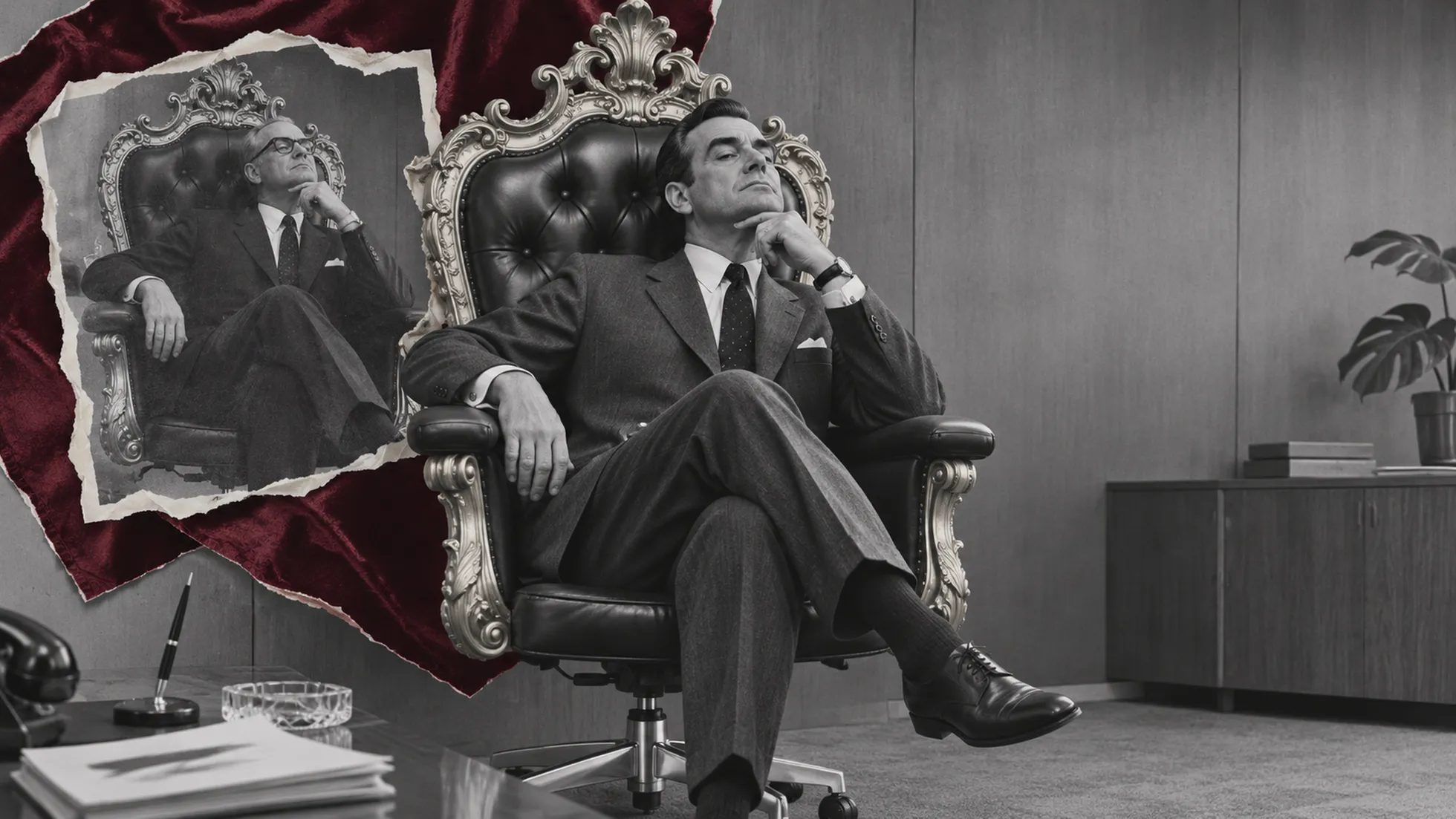
Case 08 · Filed 26 November 2026 · Amends: “Give him the throne and he’ll become the man he used to mock.”
Daniel’s first act as publisher, after 11 years of promising half of Bloomsbury that he would put the chair out on the pavement, was to sit in it.
It is a very good chair, and it deserves a paragraph. It was made in Copenhagen in 1961, in leather the colour of a well-kept liver, on a swivel base so heavy that two men from a removals firm once refused to carry it upstairs without a third. Iris, who founded the press in 1968 in a Georgian house on the north side of the square, with money from her first husband and taste from her second, bought it at auction because a poet she published had told her it was the only chair in London in which a person could look as if they were thinking. Iris left the press to Malcolm, who had been her editor, and left Malcolm, by implication, the chair, which he took to mean that he had also been left the taste. For 23 years nobody else sat in it. The cleaners dusted round it. A visiting prize judge once put her handbag on it, and editorial still talks about the silence.
So when Daniel came up to the first floor at 9.15 on his first Monday, put his coffee on Malcolm’s desk, which was now his desk, and lowered himself into the chair slowly, the way you get into a bath you suspect is too hot, the staff watched through the glass partition as if he had climbed into the coffin at a wake.
He swivelled once. He put his fingertips together. Then he looked through the glass at the production manager, who had come up to ask about the spring catalogue, and said, in a voice every person on that floor had heard him do at the pub perhaps 400 times:
“Talk me through your thinking.”
Several people laughed, because it was obviously the impression. Ben from sales laughed loudest, and then stopped, because Daniel was not laughing, and because the production manager, who had been talked through her thinking roughly once a fortnight since 2011, had gone the colour of someone asked a question to which no answer will be adequate.
It took the building six months to agree on what had happened to him. It took Daniel a lunch.
⁂
To understand that Monday you have to understand what Daniel had been for 11 years, which was the funniest man in the house and the only one with a key to the first floor.
Malcolm ran the press the way some men run a country house they have married into: with great reverence for the founder and great ingenuity about the staff. He had three phrases, and the whole building could recite them. “Talk me through your thinking” meant you were about to be told you had none. “I’m not cross, I’m interested” meant he was cross, and would remain interested for some weeks. And “Iris would never have published this” could be applied to a jacket, a font, a sandwich, a maternity policy and, once, memorably, to a novel Iris had in fact published, in 1979, which was still in print and paid for the heating.
He had one punishment, which was the Annexe: a back room on the second floor with a window onto a lightwell and a radiator that knocked. An editor in disfavour would arrive on a Monday to find their desk moved there over the weekend, with their books, their plant and their mug arranged with a terrible courtesy, as if the removal men had been told to be gentle. Nobody was told why. People spent between three weeks and, in one case, two years in the Annexe, and came out slightly quieter, the way people come out of hospital.
And he had one excuse, which covered everything: standards. The salaries were low because of standards. The interns were paid in expenses and a sandwich until 2015, because of standards. You don’t come to a house like this for the money, Malcolm liked to say, which was true, and easy for him to say, because he had come for the chair.
Daniel was the answer to all of it. He had arrived as an editorial assistant from a comprehensive in Stockport, with a degree from a university Malcolm described, in his hearing, as “a perfectly good place to have been”, and he had the gift of the person who is not quite let in: he could see the whole room. By the time he was deputy publisher he had turned Malcolm into a performance. The pub on the corner, which the staff called the Office so that they could tell their partners they were still at the Office, was where he did it: the fingertips, the half-swivel on a bar stool, the long breath through the nose before the line. He did it for assistants on their first Friday, as a sort of baptism. He did it at leaving drinks. He kept the best lines in a red notebook he called the Sayings and read from it on special occasions, the way a vicar reads a lesson the congregation already knows.
And he made promises, which the Office could also recite. When I’m in charge, Daniel said: no Annexe. No sales figures read out in the acquisitions meeting. Interns paid properly, and called by their names. And the chair goes to the charity shop on Marchmont Street on my first morning, with a note saying “free to a good home”, and I will sit on a plastic stool like a human being.
People adored him for it, and that is the part that matters. In a house where nobody could say anything, Daniel said it, in a voice, at the pub, and somehow that made the next morning possible. He had lunch with Malcolm every Friday at the Italian round the corner, “to keep the old bastard sweet”, and came back at 3pm with a story, and the story was always that Malcolm had been appalling and Daniel had been brave.
⁂
Malcolm left in the spring, for what the trade press called a well-earned next chapterstruck out: next chapter corrected to: settlement. The house had been bought six years earlier by a group that also owned a cookery imprint, a stationery brand and a podcast, and by that spring the group had received 14 formal complaints, paid two settlements and had one long conversation with a lawyer about the Annexe. Malcolm was given a year’s salary, an honorary title and a party.
The party was in the long first-floor room under the portrait of Iris, on a Thursday in May with the windows open to the square. Everyone came, because in publishing you go to the leaving party of a man you can’t stand in case he turns up on a prize jury. There were agents and authors, two former interns who now ran rival houses, and a novelist who had spent most of 2016 in the Annexe and had come, she said, to see the body. There was cava, which Malcolm would have called a decision. There was a cake in the shape of the chair, commissioned by someone in marketing, so accurate that nobody wanted to cut it.
Then Daniel gave the speech.
Everyone had known he would, and what it would be, and the room went quiet the way a crowd goes quiet before an execution it has bought tickets for. He stood under Iris with the red notebook. He thanked Malcolm for 23 years. He said he had learned everything he knew from Malcolm, which got a laugh, and that he would now share some of it, and he opened the Sayings.
He did 11 minutes. He did the fingertips. He did the swivel, on a chair from the boardroom, which did not swivel, and he said so, and that got the biggest laugh of the night. He did “Talk me through your thinking” to the group’s managing director, who had not been warned, and who began, out of pure reflex, to talk Daniel through his thinking. He did “Iris would never have published this” while holding up the drinks list, then the group’s annual report, then, after a pause he had clearly rehearsed, Malcolm’s leaving card. And he did the Annexe. He read out, in Malcolm’s voice, the name of every person who had ever been moved there, with their dates, like a war memorial, and the people on it, who were most of the room, cheered their own names. One name, Claire, 2014, got no cheer, because Claire hadn’t come.
It was cruel and it was brilliant, and it was the bravest thing anyone had seen done in that house, and the staff talked about it for weeks the way people talk about where they were when a government fell.
The strangest thing about it, the thing several people raised at the Office afterwards and couldn’t account for, was Malcolm. He did not leave. He did not do the face. He stood by the window with his cava and laughed harder than anyone in the room, until he had to take his glasses off and wipe them, and at the end he went over to Daniel and put a hand on the back of his neck, the way a man touches a dog that has won something, and said something nobody heard.
“Gracious in defeat,” said Ben from sales. “You have to give him that.”
People gave him that.
Two weeks later the group announced Daniel as publisher, and the Office ran out of prosecco at 7.40pm.
⁂
For about six weeks it was everything he had promised.
He closed the Annexe. He had it painted, put a sofa in it and called it the Reading Room, and the novelist from 2016 sent flowers. He stopped reading out sales figures. He paid the interns the London Living Wage and learned their names, and used them, sometimes twice in a sentence, which they found more unnerving than being ignored. He did not get rid ofstruck out: get rid of corrected to: get up from the chair, but nobody minded, because he made a joke about it in his first all-staff email, a good one, about how it had turned out to be load-bearing.
Then the group sent its numbers.
This is the part Daniel’s defenders tell, and they should be allowed to tell it, because it is true. The group wanted 12% off costs by March. It wanted the list cut from 40 titles a year to 30. It wanted a publisher who could “have the difficult conversations”, a phrase which, like most corporate phrases, means that somebody else will be having them on the receiving end. Daniel had spent 11 years saying what he would do if he were in charge, and it turned out that what he would do depended a great deal on who was in charge of him.
So the phrases came back. Not all at once. The first was in an acquisitions meeting in July, when Priya, who was 29, the best young editor in the house and the only person who had ever beaten Daniel at the pub quiz, pitched a debut novel set in a care home in Rochdale and asked for £15,000.
Daniel put his fingertips together.
Priya saw it. Everyone saw it. There was a silence in which several people would later swear they heard the chair swivel, although the meeting was in the boardroom and the chair was upstairs.
“Talk me through your thinking,” he said.
She did, and well. He turned the novel down for a reason that was perfectly sensible and had to do with the group, and then, as she gathered her papers, he said, in a voice that was not quite the voice, “I’m not sure Iris would have published it,” and Ben from sales made a noise like a man who has bitten on foil.
By September there were three more. “I’m not cross, I’m interested” returned in an email to publicity about a review in a Sunday paper, and Priya, who screenshotted everything, noted that it had a full stop after “cross” where Malcolm had used a comma, which was either an improvement or a measure of how hard he was trying not to do it. By October the Reading Room had a desk in it again. By November the desk had Ben.
The Office, meanwhile, had a new act. Priya did Daniel. She did him doing Malcolm, which was harder, the fingertips arriving half a second late as if he had to remember where they went. She did his emails. She did “I’ve been on your side of this table”, which was Daniel’s own phrase, the only new one, and which he used just before the worst news, the way a dentist says you may feel a little pressure. People cried laughing. It was nearly as good, the old hands agreed, as Daniel had been.
And by Christmas the Office had settled on its version of events: that power had done to Daniel what power does; that he had sat in the chair and the chair had sat in him; that he had never wanted the Annexe closed, only reassigned. “They don’t want justice,” Ben said, from the Reading Room, on the phone, to anyone who would listen. “They want their turn.”
It is a satisfying sentence, and this story is named after it. It has the merit of being true about a great many people. It was not, as it turned out, quite true about Daniel, and the one person who could have told the Office why was the one person nobody had thought to ask.
⁂
In January, Daniel had lunch with Malcolm.
He had kept it up. Nobody at the Office knew, because nobody had wondered what happens to a Friday lunch when one side of it retires. Every Friday at 12.30: the Italian round the corner, the table at the back by the coat stand, Malcolm’s veal, Daniel’s whatever-the-special, and a bottle of the Montepulciano, which Malcolm called the house’s house wine. For 11 years those lunches had been the source of Daniel’s best material. He came back from them every week with a fresh atrocity: what Malcolm had said about the marketing budget, about an author’s new husband, about the interns, whose names he did not know. The Office had taken it for espionagestruck out: espionage corrected to: correspondence. Their man went into the castle, ate the veal and came back with the plans.
The waiter, who had served them for most of a decade, put down the bread and said, “The usual,” and it was not a question.
Malcolm looked well. Retirement suited him, the way it suits men who have arranged for other people to absorb what they did. He asked about the list. He asked after Ben. Then he put his fingertips together, and Daniel, who had watched him do it perhaps a thousand times, felt his own hands start to do it under the table, and stopped them.
“Go on, then,” Malcolm said. “Do me.”
This was the arrangement. It had begun in Daniel’s second year, when Malcolm heard through a wall an assistant laughing in the kitchen and asked Daniel, at lunch, what was so funny. Daniel, who was 26 and had drunk most of the Montepulciano, told him. He did the voice. He was certain he would be sacked. Instead Malcolm laughed until he coughed, and said, “Again,” and then, when he had stopped, “What else do they say?”
So Daniel told him. Every Friday for 11 years, over the veal, Daniel did Malcolm for Malcolm, the way the Office saw him: the fingertips, the Annexe, the standards. And Malcolm listened to himself the way some people listen to a recording of their own voice, wincing and fascinated, and at the end he would say what he was going to do about it. Not much. Never the chair, never the standards, never the thing itself. But the radiator in the Annexe was fixed in 2013, because Daniel did a bit about it. The interns were put on the minimum wage in 2015 because Daniel did the expenses form. And Claire came out of the Annexe after a week instead of a year, because Daniel did her silence so well that Malcolm put down his fork.
It was the only way Malcolm ever heard anything. A man in that chair is told what people think he wants to hear, which in Malcolm’s case was nothing, so nobody told him anything at all. But he could hear a joke. He could hear himself being done, and know from which bits got the laughs exactly where it hurt. The impression was the building’s complaints procedure. It had a satirist, a pub and a veal escalope, and it worked better than the one the group later installed, which had a form.
“The impression was the building’s complaints procedure.”
And some of the Office knew. Not the young ones. But Ben had been there 19 years, and when Daniel finally told him, in the Reading Room, Ben only said, “Of course. Why do you think we said it all in front of you?” The Office had never been complaining. It had been dictating. Every grievance told to Daniel at the bar on a Thursday was a letter to Malcolm, posted for Friday, and the old hands chose their words accordingly: they knew which jokes would be repeated, and they told those louder. Nobody had to be in the same room as anybody else. And Daniel got to be the only person in the building trusted on both floors, which was the thing he had wanted, all along, more than the chair.
Malcolm asked again. “Do me.”
Daniel did him. It wasn’t very good. He had lost the timing; the fingertips came too fast. He had been using them for real for six months, and a gesture you mean is harder to perform than one you’re mocking.
Malcolm watched for a while and then said, quite kindly, “Who does you?”
“Nobody,” Daniel said. Then, because it was Malcolm, and the Montepulciano: “Priya. At the pub.”
“And who brings it to lunch?”
Daniel didn’t answer, because the answer was nobody, and because he had just understood the last six months. He had not become Malcolm because power corrupts, or not only. He had become Malcolm because he had inherited the chair and not the lunch. Malcolm had been a tyrant with an interpreter. Daniel was a tyrant without one. For half a year the building had been doing him every Thursday at the Office, perfectly, the fingertips half a second late, and none of it had reached the first floor, because the only person who had ever carried it up the stairs was sitting in the chair.
⁂
Had the Office known, it would have revised its sentence by the end of the afternoon, and enjoyed the new one more. The people’s champion was the king’s fool on a veal allowance; the rebellion was a service; the satire had belonged to the palace all along. It is very pleasant to discover that the rebel was dining at the palace. It excuses you for never having stormed it.
But both layers were true. Daniel’s rebellion was sincere. He hated the Annexe; he cried once in the Italian’s lavatory, after doing Claire. And he also loved Friday. He loved being the only one who could go up the stairs and come down again. The impression made him useful to everybody, which is the safest thing to be in a building like that, and it trained him, every week for 11 years, in exactly what Malcolm did and exactly how it landed, which is a thorough apprenticeship for a job you are telling everyone you would never take. Malcolm knew that too. He had not been tolerating a critic. He had been raising a successor, in the only way he knew, by having him study the work.
And the Office had its uses for the arrangement. A pub where you can say the unsayable on Thursday makes Monday bearable, and a Monday you can bear is one you turn up for. Every person who did the voice, or laughed at it, or asked for it again, had chosen that night not to resign. Some had excellent reasons: a mortgage, a visa, an author they could not abandon. Some were waiting. And anyone who has done a boss at the pub, and done him well, knows the drink it buys you and, under it, the small, unworthy hope that it might get back to him.
Only Claire had wanted justice. She got out of the Annexe after a week, thanks to an impression she never heard, and on the Monday she came out she handed in her notice, because she had not wanted a shorter sentence; she had wanted there to be no Annexe. She runs a small press now from a former bank in Margate, where everyone, including her, is paid the same, and the books are good, and nobody at the Office mentions her, because there is nothing to do a voice about. It is very hard to do an impression of someone who simply left. That is the trouble with justice, from the point of view of a pub. It ends the conversation.
The title of this story is unfair to Claire and too kind to the rest. Most of them did not want Daniel’s turn. They wanted something smaller and more durable: the arrangement. The pub, the voice, the man who carries it upstairs. A tyrant you can do an impression of is a tyrant you have, in a small way, arranged, and a building can live inside that arrangement for 23 years and call it a culture.
⁂
On the first Friday in February, Daniel stopped at Priya’s desk at 12.15, put his fingertips together, noticed, and took them apart.
“Lunch?” he said.
She looked at him for a long moment. Across the floor, Ben, who had come out of the Reading Room to use the kettle, stood very still with a teabag in his hand.
Priya knew what the invitation was. The Office would know by 6pm. She could say no, which is what Claire would have done, and what the Thursday-night Priya had promised everyone she would do if he ever asked. Or she could go to the Italian and eat whatever the special was and do the voice, his voice, to his face, and come back at 3pm with a story about how appalling he had been, and get Ben out of the Reading Room by March, and be trusted on both floors, and learn, every Friday, very thoroughly, exactly how it is done.
She got her coat.
The floor watched them go through the glass: Daniel holding the door, Priya doing up her buttons, and behind them, in the empty office, the chair still turning very slightly on its base, the way it does when someone has just got out of it. The Office still talks about that chair as the proof. The thing he swore he would put out on the pavement, and sat in instead; the throne; the turn. What nobody can see from the floor is that the chair has always needed two people, the one who sits in it and the one who goes to lunch, and that most of the people looking up at it would turn down the first job and run for the second.
On Thursday, at the Office, Priya did Daniel. It was the best she had ever done him. And the old hands at the bar, without quite deciding to, began to speak a little louder.
Nobody burns the chair.
End- Filed under
- The Human Contradiction
- Form
- Composite
- Length
- 3,921 words
- First published
- 26 November 2026
- Got something wrong?
- Write to us