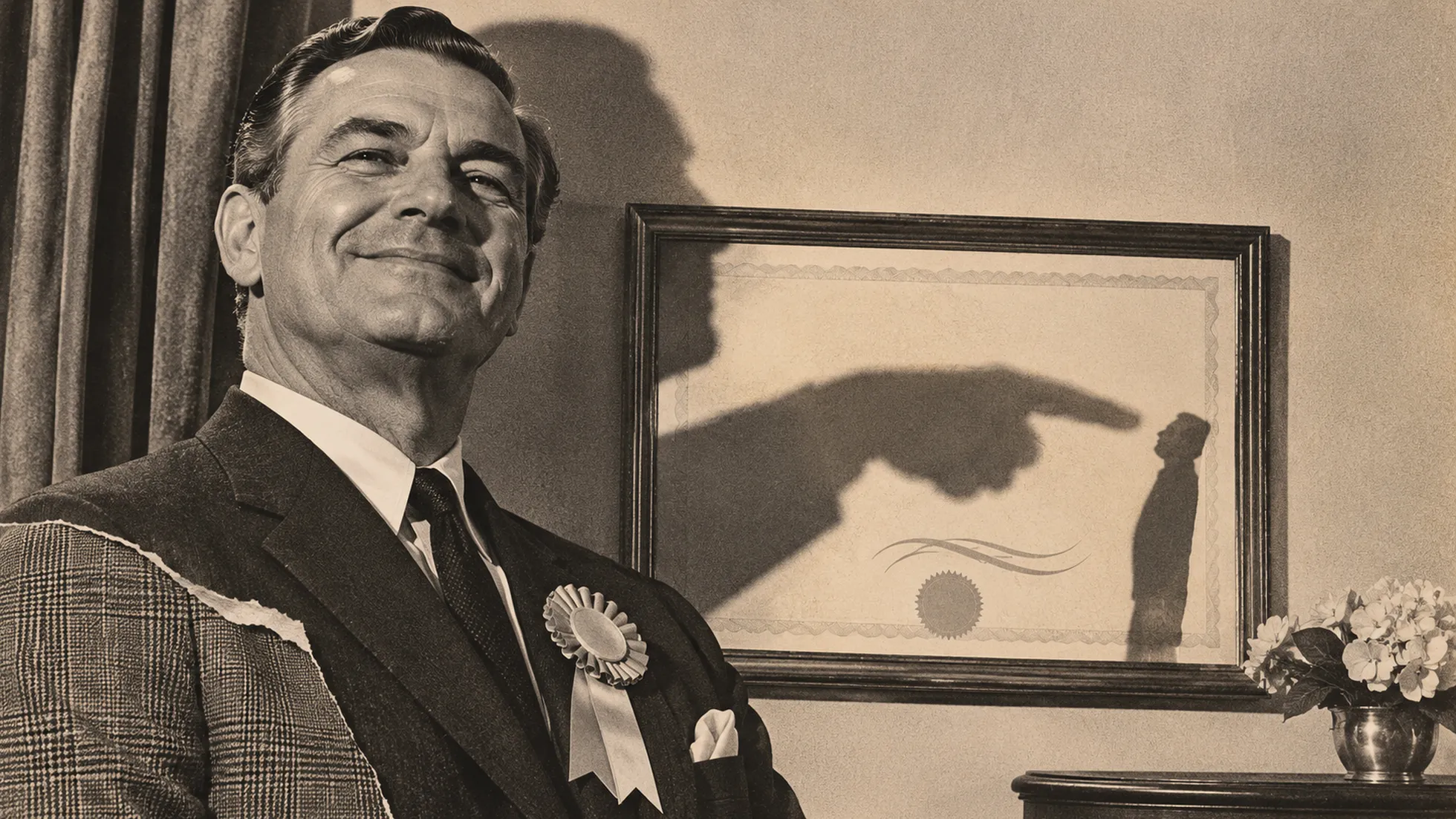
Case 05 · Filed 26 November 2026 · Amends: “A man who has never turned anyone away.”
Ray was given an award for kindness on the Thursday, and on the Friday he docked Lorraine half a day’s pay for going to watch.
It came through on the timesheets at 9.15, which is when Ray did the timesheets, at the desk by the window from which he could see the forklifts, the front gate and anybody arriving after 8am. Thursday, 2pm to 5pm: absent. Lorraine had left the yard at 2pm to have her hair done, collect a dress from the dry cleaner’s and be at the town hall by 6pm, because she had been told, in writing, that the nominee could bring guests. She looked at the timesheet for a while. Then she went into his office and said, as evenly as she said most things, that she had been at his award.
“That’s not work, is it,” said Ray.
It was not a question, and she did not treat it as one. She went back to her desk and filed the timesheet, which she would have filed anyway, because she ran the office. She had run it for 22 years, and in 22 years Ray had never lost a timesheet, or an invoice, or an opportunity to remind somebody that the kettle was not a member of staff.
⁂
The Mayor’s Civic Awards are given out every November in the assembly hall of the town hall, under a portrait of a Victorian alderman who looks as if he has just been told the price of something. There were eight categories that year. Ray’s was the last and the largest, Lifetime Contribution to the Borough, and the Mayor, a retired primary school teacher in a chain of office that weighed more than some of the children she had taught, read it out as though announcing a birth.
The citation took four minutes. Lorraine timed it, from habit. It said that for more than 40 years Ray had been the quiet engine behind half the good causes between the North Circular and the reservoirs. It said he had re-roofed the Scout hut at cost and then, when the cost turned out to be more than the Scouts had, at nothing. That he had given a minibus to the day centre and, which got a murmur, his own Thursday afternoons, for 17 years, to driving residents of the sheltered housing on Hollybush Road to the shops and back, waiting outside with the engine running and the racing pages open. It said he was a man who had never turned anyonestruck out: anyone corrected to: a stranger away.
And it told one story at length, because the nomination had, and the panel had found it very moving. Twenty-two years ago a young woman had walked into Ray’s yard pushing a pram, with a county court judgment in her handbag and three weeks left on a flat she could no longer pay for. She had come about a card in the newsagent’s window. Ray gave her the job that afternoon. He let the pram stay in the office for a year. He lent her the deposit on a new flat and never asked for it back, and on the day she moved he drove the van himself, carried a cot up four flights, and stayed to put it together, wrongly.
“The nomination,” said the Mayor, “was made anonymously, by someone who has known Ray for more than 20 years. They asked us to say only this. That he doesn’t like a fuss.”
The staff of Ray’s had been given a table at the back, by the radiator, with a card on it that said Ray’s (Guests), which Dawn from accounts had turned face down because she said it made them sound like a hostel. Dawn said, not quite quietly enough, that he’d made the pram one up. Tony, the yard foreman, said that if Ray had ever carried anything up four flights he’d have charged the stairs for delivery. Kieran, who was 20 and had been on the forklifts since March, listened to the story with his mouth slightly open, as if it were a film he had seen and enjoyed. Lorraine buttered a roll and passed it to Dawn.
“Eat your roll,” she said.
⁂
Ray was 74, and he came up to the lectern in the suit he wore to funerals and to the bank. He did not like a fuss, and he made a very good one.
He thanked the Scouts, not the leaders but the Scouts, by name, all 11 of them, and told the room which one had dropped a slate on his foot. He thanked Joan, who was 91 and at table four, for 17 years of the worst directions in east London. Then he put his notes in his pocket and talked about the day centre for six minutes without them, and the room went quiet, because he said something nobody had expected from a man in a funeral suit. He said that loneliness was a building problem. That people were put in boxes where nobody passed the door, and that he had spent his whole life in buildings, and he knew a badly designed one when he saw it. Several people in the hall wrote that down. The Mayor touched her chain.
Then he looked to the back.
“And my lot from the yard are here, I’m told,” he said. “Drinking the council’s wine on my time.”
The hall laughed.
“They’re like familystruck out: like family corrected to: paid monthly. Which means they complain about me and I pay for everything.”
The hall laughed harder, and the table by the radiator laughed too, because when your employer makes a joke about you in public you laugh at it. It isn’t in the contract, but then it doesn’t need to be.
He left before the pudding, because he had promised to drive Joan home and she got tired after 9pm. The staff watched him do it. They watched him crouch under table four to find her other glove. They watched him hold her coat at exactly the height of her arms, and walk her the length of the hall at her speed, which was slow, while the Mayor’s photographer followed them backwards and Ray waved him off with real irritation, twice. On the way past the radiator he told Tony that his tie was a cry for help. He told Kieran to come along, he’d drop him at the station, it was on the way, which it was not. He told Lorraine not to be late in the morning. Then he put a hand under Joan’s elbow and took her out into the rain as tenderly as anybody in that hall had ever been taken anywhere.
“Well,” said Dawn. “That’s the photo, then.”
⁂
Ray’s, as everyone called it, was a timber and builders’ merchant on a long strip of land beside the railway, with three sheds, a showroom nobody used and 31 staff. Ray had started it in 1985 with a van and an overdraft, and had run it since with two principles, both of which he would tell you about if you stood still. The first was that he had never once paid anybody late. Wages went out on the 28th, every month, for 41 years, including the February the bank’s systems failed and he drove round east London on a Saturday with a chequebook. The second was that he had never once paid anybody more than he had to. The yard had not had a pay rise in four years. The month Tony asked for one, in writing, with figures, as instructed, was the month the day centre got its minibus.
That was the arrangement, and the staff had their own record of it.
It was on the inside of the stationery cupboard door, in biro and marker and one entry in what was probably eyeliner, and it went back to 2009. It had no title. Everyone called it the Door. When Ray said something, somebody wrote it down, with the initial of the person it had been said to and the year, and then went back to their desk feeling better, which is what the Door was for.
If I wanted an opinion I’d have bought a parrot. (T., 2011)
You’re not ill. You’re 40. (D., 2015)
Is it a full day’s funeral or a morning one? (D., 2016)
The kettle is not a member of staff. (Everyone, ongoing)
There were more than 60 entries. Some of them were funny, and some of them, read in a row, were not, and the one from 2016 had a ring of tea round it where Dawn had once put down a mug and left it there for a whole afternoon, as if to keep it company. The first entry, at the top, was in Lorraine’s handwriting. She had started the Door. Most offices have something like it, a private record kept by the people who aren’t asked to testify. Ray had never seen it. He had never opened the stationery cupboard in his life. Stationery was staff business.
⁂
The reporter rang at 10am on the Friday, while the deduction was still warm.
He was called Josh, and he worked for the local paper, which was now mostly a website and a stack of print on Thursdays in the library. He was doing a piece on the awards. Ray had refused to speak to him. “He told me to write about the hospice instead,” Josh said, sounding wounded. Could Lorraine get him a line from the staff? Just something about what Ray was like to work for. A sentence. Something warm.
Lorraine said she would ask.
She asked in the canteen at 11am, at the tea break, which was 15 minutes and which Ray did not dock, because he had looked into it once and found that he couldn’t.
“What he’s like to work for,” said Dawn. “In a sentence. Warm.”
“That’s what he said.”
“He’s exactly the same at work as he is with the pensioners,” said Dawn. “He’ll drive you anywhere you like, and then he takes it out of your wages.”
Somebody laughed. Tony did not. He was 63 and had been at the yard for 30 years, and he was looking at his tea.
“That’s not a joke,” Tony said. “That’s what he did.”
And he told them, because Kieran had not heard it. In 2019 his wife Marion had had 14 rounds of chemotherapy at Whipps Cross, every other Tuesday, and they had no car, and the buses took an hour and a half each way and Marion was sick on the second one. Ray had found out from somebody, Tony never knew who. He turned up at their house on the first Tuesday at 7.30am in the Jaguar, with a blanket from his own sofa on the back seat and a bucket in the footwell, and drove them there. Then he sat in the car park for four hours with the racing pages, because hospitals, he said, were for people who were ill, and drove them home. He did that 14 times. He never missed one. He brought Marion a flask of soup on the days she could keep it down and a packet of mints on the days she couldn’t. She was still alive, Tony said, and she still had the blanket. He had never asked for it back either.
And on the payslip at the end of each of those months, Tony had been docked for every half-day he’d been at the hospital. All 14.
“Both,” said Tony. “Every time. I don’t know what to do with that.” He nodded at the cupboard. “So it went on the Door.”
It had. 14 half-days. (T., 2019). No quotation marks, because Ray hadn’t said anything. He hadn’t needed to.
The canteen was quiet for a while.
“He picked me up from the gate,” Kieran said.
Everyone looked at him. He had never told them this. Kieran had come to Ray’s in March through a resettlement scheme, after 18 months in a young offender institution for something he would tell you about if you asked, and nobody had asked. Ray had collected him at the gate himself, at 7am on the day of his release, bought him a full breakfast in a café and watched him eat it, and then said, “You’ll be on forklifts.” Since then he had lent him a suit for his nan’s funeral and once rung the probation officer to shout at her on Kieran’s behalf, which Kieran had found very moving.
“He’s the best man I’ve ever met,” Kieran said. “I don’t care.”
“Give it a year,” said Dawn.
“What’s that mean?”
Nobody explained it. Tony looked at Dawn. Dawn looked at the Door.
⁂
The trouble was that the canteen needed Ray to be putting it on, and he would not cooperate.
Dawn’s theory, which she had held for some years and had refined in the car on the way home from the town hall, was that the good works were guilt money: a man buying his way into heaven a roof tile at a time. It was a comfortable theory, and it had the great merit of making Ray consistent. But Josh had said that Ray had refused every interview for 30 years. There was no photograph anywhere of Ray handing over a giant cheque. The hospice, Josh said, had been made to sign something promising not to name him on the donors’ board. The Scouts had found out who paid for their roof only because a 9-year-old had read the invoice upside down. Nobody does publicity by refusing the publicity. Even Dawn could see that.
Which left the other possibility, the one nobody in the canteen wanted to say, because it was so much worse.
If Ray’s kindness was a performance, then the 31 of them were simply working for a performer, which is common and nothing personal. But if it was real (if the blanket and the bucket and the breakfast at the gate were the man himself), then he had it in him the whole time. He had all that tenderness, enough for 17 years of Thursdays, and he had looked at the people in that canteen and decided that they didn’t need any.
Everyone turned, in the end, to Lorraine, because Lorraine had been there longest and would know.
Lorraine said, “I’ll write something,” and went back to her desk.
⁂
Lorraine had a pram once.
It was navy, second-hand, with a wheel that pulled to the left, and in March 2004 she pushed it two miles along the Lea Bridge Road with Chloe in it, not yet a year old, because there was a card in the newsagent’s window that said OFFICE HELP WANTED, APPLY WITHIN, and she had nobody to leave the baby with and nothing left to lose by bringing her. She had a county court judgment in her handbag. She had three weeks on the flat. She was 29. Ray, who was 52 then and already said “That’s not work, is it” about most things, looked at her and at the pram and at the judgment, which she had brought because she thought she ought to be honest, and said, “Can you start this afternoon?”
Everything in the citation was true. She knew, because she had written it.
She had written it in March, at her desk, in her lunch hour, which was unpaid: 1,100 words in biro on the back of a delivery pad, cut to the 800 the council’s form allowed. She had asked the panel to keep it anonymous and to say only that he didn’t like a fuss, because he didn’t, and because he would be furious, and would know anyway. Then she had sat at the table by the radiator and timed the Mayor reading her sentences to a hall full of people, and when Dawn said he’d made the pram one up, she had buttered a roll.
For two years Ray was, to her, exactly the man in the citation. The pram stayed by the filing cabinet. He brought Chloe a rusk from the café every morning. He lent her the deposit, he moved the cot, he asked after the judgment and then, one day, stopped asking, and she found out later that he had rung the creditor. He was rude, and she did not mind, because underneath it, at all times, there was the steady pressure of a man who had decided you would be all right.
Then she got good at the job.
She was very good at it. By the end of the second year she had reorganised the accounts, chased £40,000 of old debts that Ray had written off in his head, and built a spreadsheet that showed him, for the first time, which of his customers were costing him money. She printed it, because Ray did not trust a screen, and stood there while he read it. He read the whole thing. Then he looked up and said, “Right,” and handed it back to her, and the following month, for the first time, he docked her for a morning at the dentist.
“The day she stopped needing him, she became staff.”
She understood it better than anyone at Ray’s, because she had been on both sides of it. Ray’s kindness was entirely real, and it had one condition, which he would have denied existed: you had to need it. Need was a door into Ray. A blanket, a bucket, a breakfast at the gate, a cot carried up four flights: these were gifts, and he gave them with a whole heart, because a gift is something nobody can ask for, and he could not bear to be asked. But once you were all right, once you were simply a competent adult with a payslip, you were owed something, and what you were owed he paid, on the 28th, on the dot, to the penny. Not a penny more. He was not ungenerous. He just could not see why anybody would need to be given what they had already earned.
It would be convenient to call that a flaw in Ray. It is more often an arrangement, and a common one. You probably know the professor who will read a stranger’s manuscript over a weekend and has not answered his own doctoral student since March; the friend who is wonderful in a crisis and cannot remember your birthday once the crisis is over. You may have been one of them on a good week. A gift is a pleasure because nobody can demand it, and it comes back as a small warm opinion of yourself. A debt comes back as nothing at all. So the strangers get the best of us, and the people we owe get what they are owed. That is usually the least of us.
And she had kept, all this time, both accounts.
She had started the Door in 2009, the week Ray docked her for Chloe’s sports day, and she had meant every word on it. She had also, for most of the 20 years since the spreadsheet, been sending Ray people. It was Lorraine who had opened the letter from the resettlement scheme, read it twice, and put it on top of his pile rather than in the bin with the others. It was Lorraine who knew Joan, because Joan had lived below her when she had the pram. It was Lorraine who found out the dates of Marion’s chemotherapy, from Tony’s face more than from Tony, and left them on a Post-it on Ray’s steering wheel. Tony never found out who had told him.
She told herself she did it for them. Some of it was for them. Some of it, she could admit at her desk at 4pm on a Friday, was for her. It was the only way she still got to see the man who had carried the cot. And it was a kind of power: nobody on the Lea Bridge Road had more say over who in the borough got rescued. Ray gave the gifts. Lorraine chose who got them.
⁂
At 4pm she went into his office with Josh’s quote, which she had written, and something else, which she had not.
Ray was doing the order book. He did not look up.
“I know it was you,” he said. “The nomination.”
“How?”
“You put ‘that afternoon’. You put it in everything. Delivery notes.” He turned a page. “You shouldn’t have done it.”
“It was true.”
“Course it was true. Doesn’t mean you should have done it.”
She waited. He did not say anything about the timesheet, and she did not ask. The deduction stood where deductions had stood since 2006. If she had asked him to reverse it he would have looked at her in real bewilderment: she was not in trouble, she was the best office manager in east London, what did she want, a medal? They had given him one. It was hanging on the back of his door, on the hook where his coat usually went.
“Who’ve you got?” said Ray.
He said it the way other men ask about the cricket. Praise made him restless, and the only cure he knew was somebody in trouble.
She put Dawn’s letter on the desk. It was from a firm of enforcement agents, about Dawn’s son’s rent, which Dawn had been paying, and which she had printed on the office printer that morning because her own had run out of ink, and then forgotten in the tray. Lorraine had found it at 11.40. She had not asked Dawn. Dawn had written on the Door more than anyone, and would sooner have sold a kidney than owe Ray a thing.
Ray read the letter. He read the whole thing. Then he folded it into his inside pocket, next to his heart, the way he kept anything he meant to deal with personally.
“Leave it with me,” he said.
She did. She knew what would happen. He would be magnificent. By Wednesday the agents would have been paid, or frightened, and Dawn would have found out, and been furious, and then cried in the ladies’. For about a year she would stop writing on the Door, and Ray would ask after her son. Then Dawn would be all right again, and go back to being staff, and the first morning she needed for a hospital appointment would come off her pay, and she would add a line to the cupboard, and never know that the whole thing had been arranged 10 feet from her desk by the only other person in the building who knew exactly how it worked.
The paper came out the following Thursday. The photograph was Ray and Joan in the rain, his hand under her elbow, his face turned from the camera in genuine annoyance, which the picture desk had cropped to look like modesty. Underneath was the line Josh had asked for: “He’s one of a kind,” said a member of staffstruck out: member of staff corrected to: the nominator, who asked not to be named.
That evening, after everybody else had gone, Lorraine opened the stationery cupboard and added a line at the bottom of the Door.
That’s not work, is it. (L., 2026)
Then she took the first draft of the nomination out of her bag, the 1,100 words in biro, and pinned it to the inside of the cupboard, next to the Door, where Ray would never look. Anybody who put the two side by side would have seen it at once. The tribute and the complaint were in the same handwriting, and both of them were true.
He never turned a stranger away.
End- Filed under
- Public Virtue
- Form
- Dramatised
- Length
- 3,890 words
- First published
- 26 November 2026
- Got something wrong?
- Write to us