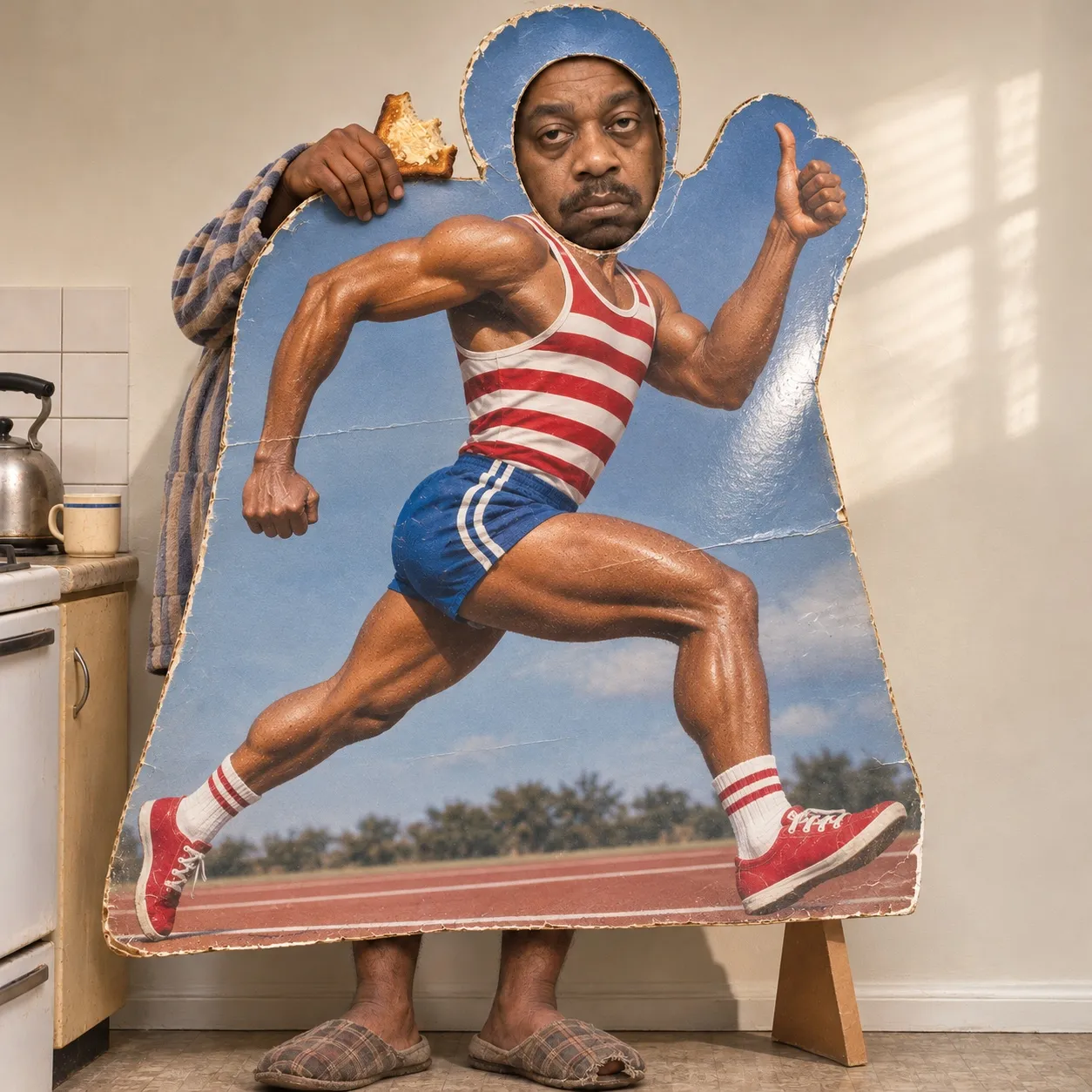
Case 02 · Filed 26 November 2026 · Amends: “This week, I become a new person.”
Second reading.
Every Sunday at 11pm, a great many perfectly reasonable adults fire themselves. The first lie arrives with them, written in a notebook that cost more than the groceries.Second reading“The first lie” is never explained here. It waits about two thousand words to tell you what it was.
The house is quiet, the dishes are done, and the life you have been living has become suddenly, spectacularly unbearable. You look around. The clothes on the chair. The glass beside the bed. The stomach you keep promising to do something about. The bank account, the messages you have not answered, the person you have become. And somewhere between the bathroom mirror and the fridge, you make a decision.
Enough. This cannot continue. Something has to change. You are going to become a different person, and not eventually: Monday. Monday is when the new person begins.
And so you perform the ancient ceremony. You delete the apps. You throw away the biscuits. You put your trainers beside the door. You download something that promises to change your life in 21 days, and order a book about discipline written by a man who appears never to have experienced a complicated emotion. You set the alarm for 5am. You open the notebook and write a list.
Drink more water. Exercise. Read. Pray. Stop overthinking. Stop apologising. Stop chasing people who
do not love you. Become emotionally available, or emotionally unavailable, if that turns out to work
better. Heal. Grow. Evolve.struck out: Evolve. corrected to: Subscribe. Become the person you were
always meant to bestruck out: meant to be corrected to: told to be.
There. A new life.
For a moment, you feel it. Hope. Not the enormous kind that announces itself from stadiums and motivational conferences, but the small, private kind that makes you straighten the bedsheets before sleeping. Perhaps this time. Perhaps this is the week. Perhaps whatever is wrong with you has finally become tired of being wrong.
You switch off the light. Tomorrow, everything changes.
⁂
Monday is beautiful. Monday has excellent manners. Monday arrives freshly washed, carrying a reusable water bottle and the confidence of a person who has never met Wednesday.
You wake before the alarm. You stretch, make the bed, and drink water while looking through the window, as though the city has gathered to witness your transformation. You listen to a podcast about emotional regulation while driving to a workplace responsible for approximately 70 per cent of your emotional dysregulation. Someone annoys you; you breathe. Someone disappoints you; you choose peace. Your mother says something that would ordinarily make you want to leave the country, and you respond with maturity. You are astonished by yourself. Who is this person? Where have they been hiding?
On Tuesday you are still impressive. The lunch is prepared, the gym bag packed, the prayers said. The journal has entries. You have begun using words such as alignment and non-negotiable.
On Wednesday you have dinner with Maya, who has known you for 11 years, which is roughly 570 Wednesdays. You order sparkling water. You decline the bread with the serenity of a monk turning down a bribe. Maya mentions that she is tired, and you tell her about a book. She mentions that her boyfriend has started cancelling plans, and you recommend boundaries. She mentions her manager, and you explain cortisol. “I know,” Maya says. “You explained it in March.” At one point you hear yourself describe a breakfast as non-negotiable. Maya listens with the patience of someone who has met several previous versions of you, most of them on Wednesdays. When the bill comes she reaches for it, because she paid last time, and the time before, and you tell her the next one is on you, as you have on most of those Wednesdays.Second readingThree Wednesdays: last time, the time before, and this one. It’s the debt the last page collects.
You have been a new person for 72 hours and are already considering a career in personal development.
Then Thursday comes. Thursday always comes.
Thursday does not arrive dramatically. That is its cruelty. There is no thunder, no great betrayal; just an ordinary day.
The alarm rings and you are tired. You slept badly because your mind decided, at 2am, to revisit something humiliating you said in 2018. The bathroom light is unkind. The face in the mirror has not changed. The stomach is still there. The old sadness has reported for duty.
You reach for your phone, just for a minute, and then 47 minutes have passed and you are watching a stranger explain why emotionally mature people never react to anything. A message arrives, not from the person you wanted but from the bank. Then your manager. Then someone asking for money. Then a photograph of two people who appear to have found a happiness that has been deliberately withheld from you. You look at it longer than necessary. You hate yourself a little for doing so, and then you hate yourself for the hatred.
By lunchtime the new person is exhausted. By evening the old person has found the spare key.Second readingThe spare key. The last line turns it round: nobody broke in.
At 10.40pm you are in the corner shop with a packet of the biscuits you threw away on Sunday, a bottle of wine and, for reasons you could not explain under oath, a scratch card, when Maya comes in for milk. She looks at the basket. She looks at you. She does not mention boundaries.
“See you next Wednesday,” she says, and you both know she means it kindly, which is worse.Second readingShe never mentions boundaries. Not mentioning them is the kindest thing anyone does in this piece.
You go home. You let your mother go to voicemail. You open the conversation you promised to leave closed. You spend money assigned to a better future. You cancel the gym. You tell yourself you deserve a break, and perhaps you do. But you know this break. It has swallowed entire months.
You sit on the edge of the bed, staring at the abandoned water bottle, and a thought arrives, quietly, with the confidence of something that has visited many times before.
Here we go again.
There is a particular humiliation in disappointing yourself. Other people can be negotiated with: you can explain, apologise, offer context. But the person inside your head has access to the complete record. Every promise. Every relapse. Every magnificent declaration made while brushing your teeth.
The mind keeps receipts, and it is a vicious accountant. It does not care that you managed three good days. It wants to know what happened on the fourth.
So you begin bargaining. Tomorrow. Next week. After the holidays. When the money improves, when I find the right programme, the right therapist, the right person, the right explanation for why I am like this. And so begins another pilgrimage: not towards a destination, but towards the hope of finally becoming somebody you can bear to live with.
⁂
There are entire industries built around this pilgrimage, and not all of them are dishonest, which would make the problem much easier. Therapy can save a life. Faith can sustain a person through unbearable suffering. Exercise can restore a body. Financial discipline can change a family’s future. There are real tools and real transformations.
But there is also a market that understands something about human beings: we are terribly easy to sell to when we cannot stand ourselves. We will buy almost anything that promises to introduce us to a version of ourselves we might finally admire.
Every era has its costumes. One year the answer is prayer; the next, positive affirmations. Then fasting, then Pilates, then a complicated relationship with ice water. Then forgiveness, then refusing to forgive because somebody online has explained that forgiveness is a form of self-abandonment. Then a woman with an extraordinarily peaceful voice explaining that suffering comes from resisting abundance. Abundance, apparently, has been trying to reach you. You simply have not been vibrating correctly.
You watch the video. You are not entirely convinced. But she seems happy, and the house behind her is beautiful, so perhaps she knows something. You subscribe. Of course you subscribe. At this stage, hope has become a recurring direct debit.
What makes the spectacle tragic is that people are not foolish. They are tired, and tired people do not always want truth. Sometimes they want instructions: seven steps, five habits, a 30-day challenge, something with a beginning, a method and a finish line. Do these things. Avoid those things. And eventually you will become whole.
Whole. What a demanding little word. It suggests that somewhere there exists a finished version of you: someone who has forgiven every parent, outgrown every humiliation, mastered every appetite and achieved a permanently civil relationship with their own reflection. No internal committee meeting. No strange sadness while washing a plate. No elaborate arguments with people who are not present. A human being, fully assembled.
We keep looking for this person, in books, in churches, in romantic relationships, in the bodies of
strangers who appear remarkably comfortable being photographed. We call it
self-improvementstruck out: self-improvement corrected to: a change of address.
⁂
Consider the woman who has been in therapy for two years. She has learned the language: attachment, triggers, boundaries, people-pleasing. She knows why she stays too long, why she apologises for things she did not do, why silence from another person can feel like a verdict on her entire existence. She has made genuine progress. She has begun saying no, and sometimes she even believes herself.
Then she meets someone kind, funny, interested; someone who remembers how she takes her coffee. For a while she is magnificent. Then one evening the person becomes distant. Nothing dramatic. A shorter message, an unfamiliar tone, a change in rhythm. And suddenly the old house inside her catches fire.
She checks the phone. She checks again. She reconstructs the last conversation, searching for the moment she became too much. She knows exactly what is happening. She could explain it to an audience, draw a diagram, probably teach a workshop. But there she is, at midnight, holding a phone, feeling 12 years old. And the cruellest part is not the fear. It is the shame of still having it. I thought I was past this. As though healing were a country you could enter and never be deported from.
Or consider the man who decides to become strong. Not merely fit: strong enough that nobody will ever mistake him for weak again. He rises early, lifts weights, measures food. People call him dedicated, impressive, a machine. They do not see the changing room in 1997, or how often it comes to the gym with him.
Perhaps he genuinely loves training. Good. But sometimes, beneath the discipline, an old negotiation continues. If I become strong enough, perhaps I will stop feeling small. If I become indispensable enough, perhaps nobody will leave. If I become good enough, perhaps I will finally be allowed to rest. This is the secret contract behind so many respectable ambitions: we want the achievement to settle a debt that has been accumulating since childhood. And when it doesn’t, we assume we have not achieved enough. The wound keeps moving the finish line, and because ambition is socially admired, nobody thinks to ask whether the runner is enjoying the race.
Some people go further and become experts in helping everyone else. They can identify manipulation from across a restaurant. They know the difference between accountability and shame, love and dependency. They are fluent in the language of healing, and yet they go home and cannot sit quietly with themselves, so they help another person, and then another. You can spend an entire life illuminating other people’s rooms because you are frightened of what the light might reveal in yours. It doesn’t make them hypocrites. It makes them the people we ring.
“We are terribly easy to sell to when we cannot stand ourselves.”
I wonder when we started treating the human condition as a defect. There was a time when a person could be unhappy for an afternoon without concluding that their entire identity required reconstruction. Now a bad mood can become a six-part investigation. Perhaps it is childhood trauma. Perhaps it is cortisol, or attachment style, or your gut. Perhaps it is Mercury, or, if you are the sort of person who laughs at Mercury, your attachment style.
The internet has given human suffering an almost unlimited wardrobe. Every feeling can be dressed as a revelation, every disappointment as a lesson, and every pattern can become content. A name is comforting. It makes the problem feel manageable, as though the mind, having received an explanation, is now obliged to stop hurting.
Unfortunately, pain is not particularly impressed by vocabulary. You can understand exactly why you fear abandonment and still feel sick when somebody takes too long to reply. You can know that comparison is destructive and still feel something ugly when a friend announces wonderful news. You can understand yourself perfectly for five minutes, and then receive a message from your father.
And yet people do change, and that matters. People leave destructive relationships. People recover from addictions. People become kinder. Some transformations are extraordinary; others are so small that nobody notices. The woman who once spent the entire night waiting for a reply now puts down her phone after 10 minutes. She is still anxious, but she sleeps. The man who once responded to every criticism with rage now takes a walk before speaking. He is still angry, but nobody is frightened of him tonight.
These changes will not sell out an auditorium. Nobody will produce a documentary about the evening a man felt rejected and managed not to punish his family for it. Sometimes change is just recognising the familiar disaster five minutes earlier than you used to, which is roughly the length of a phone call to your father.
We are remarkably cruel to ourselves about anything less. You miss the gym: you are lazy. You cry over the person again: you have made no progress. You lose your temper: you are becoming your father. The event lasts an hour. The sentence lasts years. We do not merely experience setbacks; we conduct trials. The defendant is nearly always ourselves. The prosecution is enthusiastic, the defence is rarely prepared, and the judge has been awake since 3am.
And there is something almost offensive about how ordinary life carries on while a person is undergoing enormous private suffering. Your heart can be breaking; the kettle still needs descaling. You can finally forgive somebody who hurt you 15 years ago; the electricity meter remains unimpressed. Life does not suspend its administrative requirements while you become a better person.
So next Sunday will come. Eleven at night, the house quiet, the notebook on the bedside table with three good days in it. You will feel the old urge: throw everything away, buy another notebook, announce another transformation. I would like to say something wise here, so let me try.
Put down the phone. Leave the dishes for a moment. Drink a glass of water. Be gentle with yourself; there is no prize for…
I notice I have started giving instructions. Two thousand words in, and I am already considering a career in personal development.Second readingThe essay catches itself becoming what it mocks: Wednesday’s person, giving advice.
So instead, let me go back to the first lie, the one that arrived on Sunday night in the expensive notebook. It was never that you would change. People change; I have watched them do it, slowly, badly, 10 minutes at a time. The lie was that you would become someone else.
Someone else has a wonderful advantage. Someone else doesn’t owe anyone anything. Someone else didn’t say that thing in 2018, didn’t let Maya pay three Wednesdays running, didn’t stop returning their mother’s calls. Someone else starts on Monday with a clean account, and the accountant in your head, the vicious one with the receipts, is told he has the wrong address. That is what the notebook was for. Not improvement. A change of name on the account.
It is a very respectable way of not paying. You don’t have to apologise to Maya if the person who lectured her about boundaries is about to be replaced. You don’t have to ring back if you are about to become somebody who rings. Every Sunday the debts are written off; every Monday a new person moves in with nothing owing. It feels like hope. Financially speaking, it works like a bankruptcy.
Which is why Thursday comes. Not as a relapse: as the post. The bank, your manager, the person asking for money, the photograph of other people’s happiness were never temptations sent to test the new you. They were addressed to the old one, at the only address you have.
And somebody pays for your rebirth. Usually it’s the people who get the new person on Monday and the old one on Thursday, and are expected to treat both as a fresh start: the friend who hears about boundaries on Wednesday and meets the scratch card on Thursday; the mother who is answered with maturity for three days and then not rung at all. They never get a new person. They get a series of first impressions, and the bill.
The unglamorous alternative isn’t becoming someone else. It is settling up as the person you are. It looks like ringing your mother on a Thursday with nothing to report, paying for the next dinner, an apology without the paragraph on why your cruelty was understandable. None of it will sell a single notebook.
Across town, Maya is putting the milk away. She has met every new you there has been. She paid for most of them.
Thursday isn’t a break-in. You never needed the spare key. It was always your house.Second readingMaya turns up again in a case still being written, Your Absence Is Their Favourite Conversation. She hasn’t been paid back.
It was always your house.
End- Filed under
- Private Lives
- Form
- Composite
- Length
- 2,990 words
- First published
- 26 November 2026
- Got something wrong?
- Write to us
Since publication
We reported that you had become a new person on Monday. The previous occupant has asked us to point out that the mortgage is still in your name.