Case 07 · Filed 26 November 2026 · Amends: “A marriage of faithful love, and an example to us all.”
At their pearl anniversary lunch, Clifford told 140 people that his wife was the first person he talked to every morning, which would have been news to his wife.
“Yvonne,” he said, “is the first person I talk to every morning, and the last voicestruck out: voice corrected to: door I hear at night.” He said it standing, in his good suit, with one hand on the back of her chair, and the church hall made the noise a church hall makes when it has been given exactly what it came for. Yvonne put her hand over his. Their hands knew how to do this. They had been doing it in the front row every Sunday for 30 years.
The last full sentence Clifford had said to her at home had been at Easter. It was: “The man’s coming about the boiler on Tuesday, so somebody will need to be in.” Somebody had been in. It was Clifford. They had not discussed it further.
Pastor Desmond had done the serious part before lunch, in the service. He had called them to the front during the notices and laid a hand on each of their heads and prayed, in the slightly louder voice he kept for weddings and the sick, for “the marriage every young couple in this church should be praying for”. The notice sheet, folded into every hymn book, said: Join us in the hall to give thanks for 30 years of Yvonne and Clifford: a marriage of faithful love, and an example to us all. There were four engaged couples in the congregation that morning. All of them had been on Yvonne and Clifford’s course. All of them looked at the front row the way people look at the summit in a documentary about mountaineering.
Yvonne had made 11 trays of food and a decision. The food was on the trestle tables under cling film. The decision was in her handbag, on the back of a gift-aid envelope: an address in Croydon, a one-bedroom flat above a dentist, £1,350 a month, viewing Tuesday, 12.30, her lunch hour. She had written it on the envelope because it was what was to hand, and kept it there because it was the only piece of paper in her life that nobody else had seen.
She had decided, some time in the summer, that she would let them have the party. You don’t leave before a party in your honour. It would be rude.
⁂
Nobody had done anything. That was the difficulty. There was no other woman, no debt, no door slammed hard enough for the neighbours. There was nothing to forgive, which meant there was nothing to make up afterwards.
What there had been was Simone. For 18 years their daughter had done the talking in that house, at dinner, in the car, on the stairs, about everything, and her parents had answered her, and through her, each other. In September 2015 she went to university in Leeds, and on the first evening without her Yvonne and Clifford sat at the kitchen table in a silence so complete they could hear the fridge thinking. They had assumed they had a marriage. It turned out they had had an interpreter.
By Christmas Clifford had moved into the box room, on account of his snoring, which was real. By the spring the snoring had become the official reason for a great deal. The house learned a new way of working. The kitchen calendar was its parliament: CLIFF MEN’S BREAKFAST 8AM in his capitals, Y LATE PARENTS’ EVENING in her joined-up hand. He went up at 10pm. She went up at 11.30, after the news, which she watched with the volume on four. They passed on the landing in the mornings the way two clerks pass in a corridor, with a nod that acknowledged the other’s employment. He drove to the test centre, where for 22 years he had sat beside strangers saying almost nothing and writing down their mistakes; he was, his colleagues agreed, very good at it. She drove to the secondary school where she ran the office and spoke, she once calculated, to about 300 people a day, which was 300 more than she spoke to at home.
“They had not had a row in 11 years. You need to be speaking to have one.”
It was not hostile. That is the part outsiders never believed. Hostility takes energy, and attention, and a sense that the other person might still change. What they had was quieter and more efficient than hatred: two adults who had stopped expecting anything and had become extremely courteous about it. If the milk ran out, the milk was replaced. When his mother was ill, Yvonne drove him to Birmingham, and they listened to the radio, and she made his mother laugh, and on the way back he said “Thank you”, and she said “Of course”, and that was February.
And on Thursdays, they talked. Thursdays didn’t count. Thursdays were scripted.
In 2017 Pastor Desmond had asked them to take over the marriage-preparation course, eight sessions in the room behind the hall, because the couple who used to run it had moved to Milton Keynes. Yvonne and Clifford had looked at each other, a real look, the first in some time, and said yes, because there was no way of saying no to a pastor that would not have required an explanation. So every Thursday night, at the kitchen table, they prepared. Session one: Expectations. Session three: Money. Session four: Communication. They went through the handouts line by line. They agreed who would take which part. They rehearsed. “When your partner says something that upsets you,” Clifford would read aloud, “what do you do before you answer?” And Yvonne would say, “You breathe, and you ask yourself what they meant,” and he would nod and make a note, and for 40 minutes a week, in character, they were the most attentive couple in south London.
The engaged couples adored them. Twenty-six had been through the course in nine years. Twenty-four were still married, which Pastor Desmond mentioned in sermons, and which made the two in the front row lower their eyes in a way the congregation found very moving.
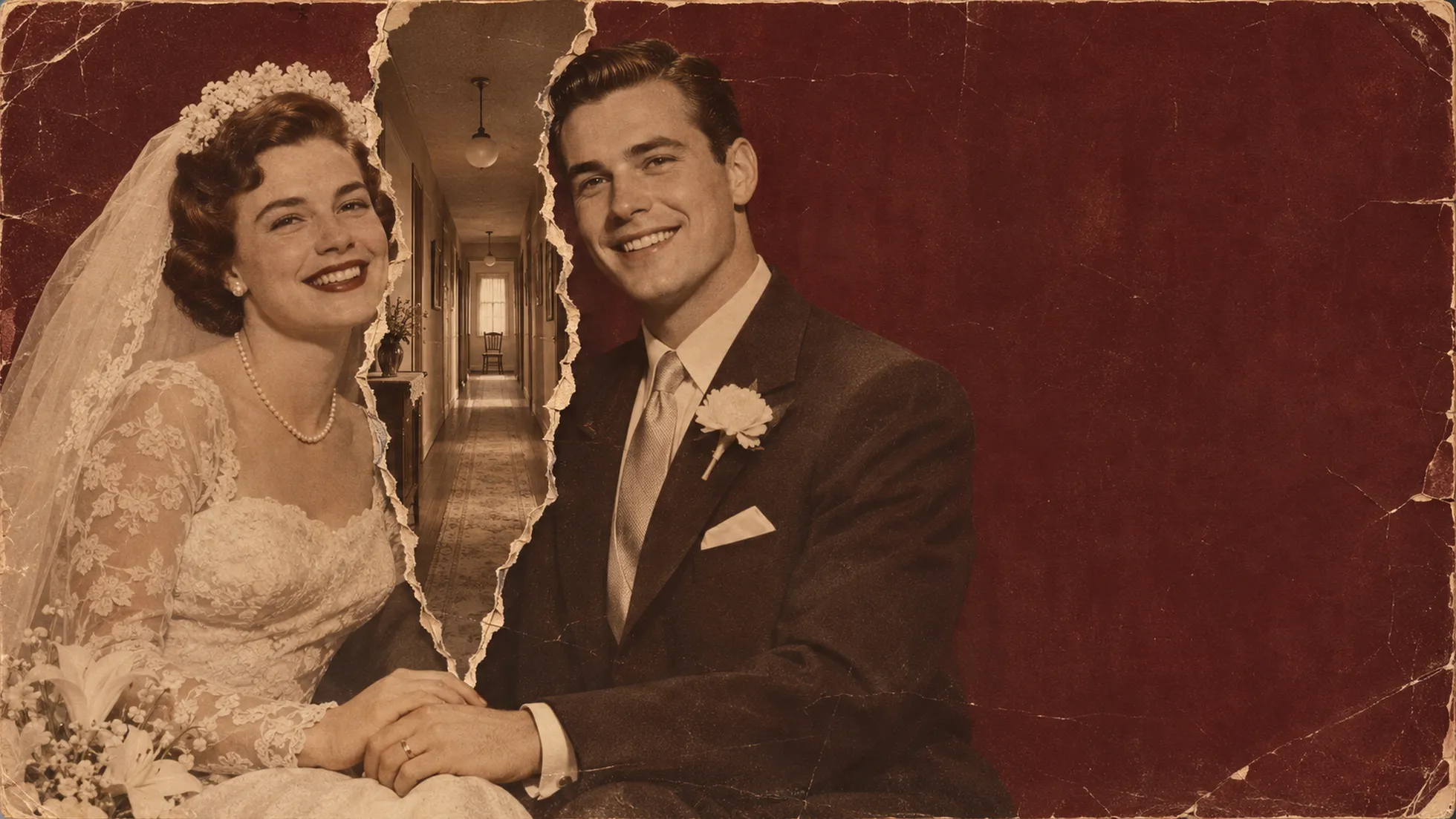
Neither of them would have said the admiration mattered. It did. Clifford, who had been a quiet boy and was a quiet man, was the man young husbands rang for advice. Yvonne, whose mother had been left in 1979 with three children and a sewing machine, was the woman who had made it work. On the stairs hung the wedding photograph from October 1996: a 25-year-old in a dress with sleeves like two meringues and a 28-year-old in a hired suit who had practised his vows in the car. They passed it, separately, several times a day. Neither of them wanted to be the one who told those two that it hadn’t worked.
Simone knew, of course. She had found her father’s slippers under the box-room bed her first Christmas home. She was 29 now, and lived in Hackney with Tom, who lectured in media at a university he described as “post-92, which is actually the interesting end”, and who had stayed at the house exactly once, in 2023. Tom had noticed the bedrooms within an hour. At dinner parties in Hackney, between the natural wine and the conversation about whether it was ethical to have children, he had been doing Yvonne and Clifford ever since: the church, the hand-holding, the course (“they teach communication”), and the two closed doors at either end of the landing. “It’s pure theatre,” he would say. “It’s actually quite sad.” People agreed that it was actually quite sad, and asked him to do the bit about the boiler again.
⁂
The lunch was dry, so everything that was said was said sober.
Marcia went first. She was Clifford’s elder sister, and she had been asked to say “a few words”, which in Marcia’s case was a figure of speech. She stood at the end of the top table with a glass of elderflower cordial and told the hall that when Clifford had announced in 1995 that he was going to marry Yvonne, she had given it two years.
“Two years,” she said again, in case anybody at the back had missed it. “And look at them.”
The hall looked at them. Yvonne and Clifford sat very still, as people do when they are being looked at, and the hall applauded, a little longer than it needed to.
Then Marcia told the story of the wedding day, when Clifford’s car had broken down on the A23 and he had arrived 40 minutes late, “and she waited, she waited, and that tells you everything you need to know about this woman”. It did tell you something, Yvonne thought. She had been waiting, in one way or another, for most of the time since.
Then the cake. Joy from the hospitality team had made it: three tiers, ivory icing, a choker of sugar pearls round each tier, and on top two small porcelain figures that Joy had found online and that looked, everyone agreed, just like them, if you didn’t look closely. Joy insisted they cut it together. Clifford put his hand on the knife; Yvonne put hers over his; 140 phones went up. Their hands knew this too. Their hands had a better marriage than they did.
It was during the cake that Tom asked his question.
He had said “amen” all morning in a tone he believed to be neutral, and watched everything with the bright, tender look of an anthropologist who has been allowed into the ceremony, and by the cake he could not help himself. He leaned across the top table, smiling, and said, loud enough for the nearest three tables, in the voice he used for students who were about to be wrong:
“So what’s the secret, Clifford? Thirty years. What’s the actual secret?”
Simone closed her eyes.
Clifford considered the question with the care he gave a reversing manoeuvre. Then he said:
“Separate bedrooms.”
The hall laughed. It laughed generously, and warmly, and for a fraction too long, the way a congregation laughs when the pastor makes a joke about his own weight. Pastor Desmond laughed. Marcia laughed so much she had to sit down. At the table by the urn, Ivy, who was 81 and had run the church’s prayer chain since 1987, laughed with her hand over her mouth, and then took a small notebook out of her handbag and wrote something in it.
Tom turned to Simone with an expression of pure joy. “He said it,” he whispered. “He said it out loud. And they laughed.”
“Don’t,” said Simone.
“They think it’s a joke.”
Leah and Daniel came over next, the youngest of the engaged couples, marrying in March, with Leah’s mother in tow. Leah’s mother wanted the advice. Not the course; the real advice. The thing Yvonne would tell her own daughter.
Yvonne smiled at her. She had been asked this at least once a month for nine years and kept an answer ready, the way you keep a spare umbrella in the car.
“Never go to bed angrystruck out: angry corrected to: at the same time,” she said.
Leah’s mother wrote it on her napkin.
⁂
Simone found her mother in the church kitchen afterwards, scraping rice into foil trays for people to take home, which is the part of any church function where most of the theology happens.
“Mum.”
“Pass me the cling film.”
“Mum. You can stop now.”
Yvonne went on scraping. She had known since Simone was six that this voice meant her daughter had been rehearsing, and lately that meant with Tom.
“Stop what?”
“This.” Simone pointed at the hatch, beyond which 140 people were collecting their coats and their foil trays and saying what a beautiful day it had been. “You’ve done 30. You did the party. Nobody could say you didn’t try. You’re allowed to go.”
Yvonne took the gift-aid envelope out of her handbag and put it on the draining board, and Simone read it, and put her hand over her mouth, the way Ivy had.
“Tuesday?”
“My lunch hour.”
“Mum.” Simone was crying now, the way her father did at films, without moving her face. “Tom will be so pleased.”
It was not, Yvonne thought, quite the right thing to say. But it was true. Tom would be delighted. Tom had been waiting three years for a third act.
Simone went out to the car park to find her father, and found him in the driver’s seat of the Corolla with the engine off, which was where Clifford went on Sunday afternoons to do what he did on Sunday afternoons, which was nothing, in a car, by himself. She got in the passenger side. He didn’t look surprised. He was a driving examiner. People got into the passenger side of his life all the time.
“You all right, Dad?”
“Lovely day,” he said. “Your mother’s food.”
“It was.”
They sat. A pigeon walked the length of the bonnet and inspected the wipers.
“I’ve got a meeting with Pastor on Monday,” Clifford said, to the windscreen.
“About what?”
He thought about it for the length of a red light.
“Your mother,” he said, “has been very good to me.” And then, which surprised them both: “She deserves somebody who talks.”
Simone did not tell him about the envelope. She went back to Hackney that night and told Tom, who said, “Oh, that’s wonderful,” and meant it, and then, a little later, in bed, “I wonder what she’ll do about the house,” and then, “It’s actually a really interesting case.”
⁂
Ivy came on Monday at 7pm, while Clifford was at the church with Pastor Desmond, with a foil-covered plate of Sunday’s leftovers that nobody had asked for and a ring binder under her arm.
She was small and slow, and she had the manner, common to women who have run something for nearly 40 years without ever being put in charge of it, of a person who does not need to ask whether she can come in. She came in. She put the plate on the counter and the binder on the kitchen table, on top of Session five: Forgiveness.
“Angela says you’re looking at a flat,” she said.
Angela was the estate agent in Croydon. Angela also sang alto. Yvonne had not known that the two Angelas were the same Angela until that moment, and as she sat down she understood, with the clarity of a woman who has organised a great many church functions, that she would never again know anything about this congregation before it did.
“It’s just a viewing,” Yvonne said.
“Course it is.”
Ivy opened the binder.
The prayer chain had been Ivy’s since 1987. Requests came to her by phone, and later by text, which her grandson had set up and which she now used with alarming fluency, and on Wednesday evenings she rang them round, ten names at a time, to the 30-odd women and four men who had agreed to pray. Most requests were for a week, or a month. Operations. Exams. A son in prison, a daughter in Dubai, a job interview, a court date, a biopsy. When a request was answered, Ivy drew a neat line through it and wrote the outcome in the margin in green: Clear. Passed. Home. With the Lord.
She turned the binder towards Yvonne and opened it at a page from January 2016.
Yvonne and Clifford: for the marriage.
Yvonne turned the page. It was there again the next Wednesday. She turned several pages at once. It was there. It was there in 2017, between someone’s hip and someone’s visa. It was there through the whole of 2020, when the chain had run by phone every night for four months, and it was there last Wednesday, in Ivy’s small upright hand, with no line through it, because it had not been answered.
Ten years. Every week. On Sundays they had been prayed for, by name, from the front. On Wednesdays, it turned out, they had been prayed about.
“The marriage every young couple in this church should be praying for,” Pastor Desmond had said on Sunday, with his hands on their heads, and 30-odd people in the hall had known precisely what he meant.
“Who,” said Yvonne, and then could not think how the sentence ended.
“Marcia,” said Ivy. “Boxing Day, 2015. She came to you for lunch, and afterwards she sat in her car outside your house for ten minutes, and then she rang me.” She closed the binder, gently, the way you close a hymn book when the hymn has finished. “After that it was a formality, darling. Everybody knew.”
What everybody had done about it took Ivy about 20 minutes to explain, and she explained it without any sense that it needed justifying, as if she were going through the arrangements for a funeral tea.
The course had been Ivy’s idea. Pastor Desmond had needed someone after the couple went to Milton Keynes, and Ivy had said: give it to Yvonne and Clifford. They’ll have to sit at one table every Thursday to prepare it. Two people can stop talking to each other, she said, but they can’t stop talking to each other about a handout. The men’s breakfast made a point of seating Clifford beside someone who would ask after his wife, so that once a month he had to say her name and something true about her. The women who rang Yvonne rang her because they had been asked to. The annual blessing of couples, which always seemed to fall on their anniversary Sunday, fell on it because it had been moved there in 2016. And the party, the hall, Joy’s cake, Marcia’s speech, the notice sheet, had been booked in 2024 by a committee of five women in Ivy’s front room, who had agreed that whatever else was true of Yvonne, she would never leave before a party in her honour.
“We gave you something to get to,” said Ivy. “That’s all. People need something to get to.”
Yvonne took the notice sheet out of her handbag, where it had been since Sunday, and read it again. A marriage of faithful love, and an example tostruck out: an example to corrected to: a job for us all.
“So when he said separate bedrooms,” she said.
“We laughed,” said Ivy. “It was the first time he’d said it. We were so proud of him.”
⁂
Tom, when Simone told him, said it was surveillance. He said it was the most controlling thing he had ever heard: a whole institution keeping two unhappy people in a marriage for the sake of its own image, using the language of prayer to manage a reputation. He said it was, in fact, his entire second-year module.
He was not wrong, exactly. A congregation that needs an example will hold it up whether or not the example would like to be put down. Pastor Desmond did need his 24 out of 26. Leah and Daniel did need something to look at in the front row. Ivy did need her binder. Being held up is also a way of being held in place, and the people doing the holding are rarely the ones who notice the difference.
But Tom had known for three years, and what Tom had done with it was a bit at dinner parties. The 30-odd women and four men had known for ten, and what they had done with it was ring each other every Wednesday and give up a Sunday to a party. One of these is a performance. It is not obviously the one in church.
And Ivy, at the front door, with her coat buttoned to the neck, had said the thing a church is not supposed to say.
“If you go, you go,” she said. “We’ll pray for that too. We’re not fussy, darling. We just like to be kept informed.”
That was the part Yvonne lay awake over, at 11.30, in the room at the end of the landing. Not that she had been seen through. That she had been so proud of not being seen through. Eleven years of the front row, of the hands, of Session four: Communication delivered word-perfect to couples who wrote it down: the best performance of her life, given to an audience that had known the whole time, and had clapped anyway, because they could see how hard she was working. It is a terrible thing to discover you have been loved instead of believed. Most of us would rather be believed. It feels more like an achievement.
And if the reader, like Tom, would quite like Yvonne to sign for the flat above the dentist, would like the suitcase and the door and the clean ending in which a woman walks out of a respectable lie into her own life, it is worth asking who that ending is for. It would make a better story. Tom would tell it beautifully. And none of us would be helping her move.
⁂
Angela showed her round on Tuesday at 12.30 and did not mention the choir once, which Yvonne would remember as one of the great acts of Christian restraint she had witnessed. The flat was clean and bright, with a view of a bus stop and a smell of mouthwash from downstairs. Yvonne stood in the middle of the empty living room and listened. It was quiet. It was exactly as quiet as her kitchen. The only difference was that nobody in Croydon would be praying about it on Wednesday.
She said she would think about it. Angela said of course.
Clifford’s meeting with Pastor Desmond had lasted two hours. He did not say what was said in it, and she did not ask, but on Thursday night he came down at seven, as usual, with the folder for Session five, and sat at the kitchen table, as usual, and did not open it.
“Pastor says everybody knows,” he said.
“Ivy came.”
“I thought she might.”
The fridge thought about it.
Then Clifford said, to the table, slowly, like a man reading his own handwriting: “I’d like to keep doing the course, if you’re going to be here, and if you’re not going to be here I’d like you to tell me before you tell Ivy, because I would like to hear one thing in this house before the church does.”
It was the longest sentence he had said to her since 1996. Nobody was watching. Nobody had a phone up.
“I haven’t decided,” Yvonne said.
It was not much of an answer. But it was the first thing either of them had said in that kitchen in 11 years that was not about the boiler, or the handout, or for the benefit of someone who wasn’t there, and they sat with it for a while, the way you sit in a car after a test, before anyone tells you how you did.
On Wednesday Ivy rang the chain, ten names at a time. Someone’s hip. Someone’s visa. When she reached the page for Yvonne and Clifford she took out her green pen, and then, after a moment, put it back, took out the blue, and changed the entry instead, so that it read: Yvonne and Clifford: for the marriagestruck out: the marriage corrected to: both of them.
Everybody knew. Everybody came. They are still praying. They have simply stopped telling God which outcome they would prefer.
Everybody knew. Everybody came.
End- Filed under
- Private Lives
- Form
- Dramatised
- Length
- 3,877 words
- First published
- 26 November 2026
- Got something wrong?
- Write to us