Case 04 · Filed 26 November 2026 · Amends: “With love and thanks to the friends who were always there for him.”
By the time Edward died, everybody had found the time.
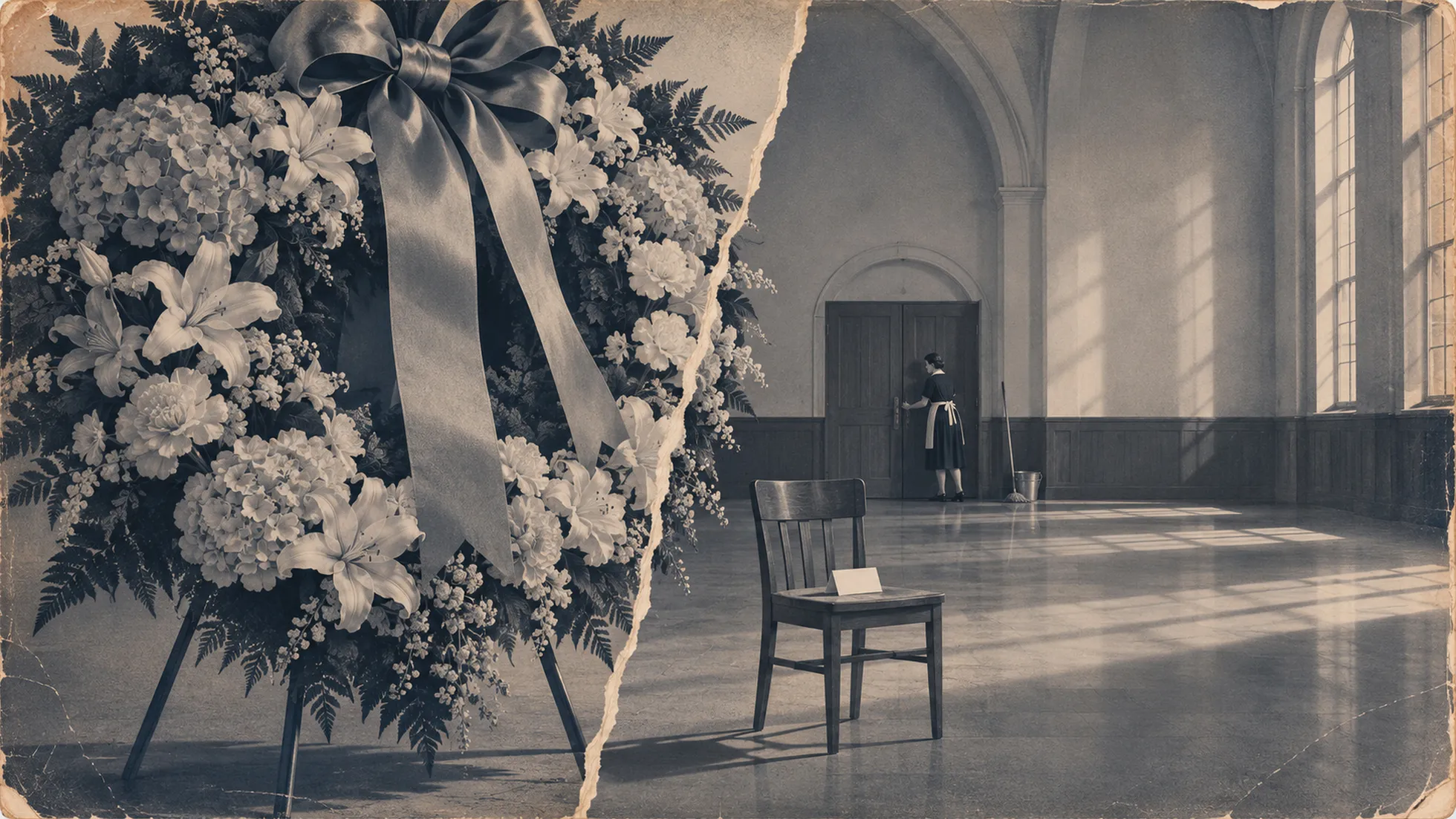
His cousins came down from Leicester, a city they had described for 11 years as “a bit far”. His son flew in from Dubai, business class, which he mentioned twice before the first hymn. The insurance firm where Edward had managed the buildings for 34 years sent a wreath so large that the funeral director had to angle it through the church door like a sofa, with a card that described him as irreplaceablestruck out: irreplaceable corrected to: replaced the following Monday. A woman from the choir who had never met him cried during the second reading and said afterwards that it was the atmosphere.
There was one guest the family did not want.
His daughter had telephoned the funeral director on the Tuesday and asked, in the voice she used for school governors, that a particular woman not be allowed inside. She gave a description: about 60, grey bob, a navy coat she would almost certainly be wearing. The funeral director, a man called Colin who had perfected an expression of sympathy he could hold for 90 minutes, said that this was unusual but not unheard of. He asked whether there was likely to be a scene. The daughter said there was not. The woman, she said, had never made a scene in her life. That was rather the point.
At 10.40 the woman arrived in the navy coat. Colin met her at the gate with his expression on. They spoke for less than a minute. She did not argue. She walked back across the car park and sat on the low wall by the bins, with her handbag on her knees, facing the church, as if she had come to wait for a bus that she knew would be late.
Inside, people noticed. People always notice the person who isn’t allowed in. It is the only guest anyone talks about afterwards.
⁂
Hannah had organised everything, and it showed.
There was a spreadsheet. There was a seating plan, which nobody follows at a funeral, and which Hannah had printed anyway, in case. There was an order of service on heavy cream card, with a photograph of Edward at 40 holding a fish and squinting as if the fish had said something stupid. Inside, under the hymns, it said: With love and thanks to the friends who were always there for himstruck out: always there for him corrected to: always meaning to call.
The friends filled 11 pews. They were the kind of friends a man accumulates by staying in one place: the neighbour from before the neighbour, two men from the bowls club, a former secretary who had sent a card every Christmas and been sent one back, an arrangement that had outlived the reason for it by a quarter of a century. They had all been meaning to call. Several of them said so, at the door, to Hannah, in the tone people use for a debt they plan to settle in the next life. She thanked each of them. She was very good at thanking people. She did not say what everyone could see she was thinking, which was that her father had a landline, and that it had worked.
Michael did the eulogy.
He was 46, two years younger than his sister, and he had the confident, apologetic manner of a man who has been forgiven for a great deal because he lives abroad. He had visited twice in four years. He had sent a hamper every Christmas, from a company that also did corporate gifts, so that Edward had spent several Decembers eating the same chutney as the clients of a logistics firm in Jebel Ali. Michael stood at the lectern and unfolded his notes and looked at the congregation for a long moment, which is a technique, and then he said:
“Dad was my best friendstruck out: my best friend corrected to: a man I rang at Christmas.”
There was a murmur of the specific kind a congregation makes when it would like to believe something. Michael told the story about the fish. He told the story about the time Edward drove the wrong way round the Bromley one-way system for a full lap rather than admit it. He was funny, and warm, and he cried at the right place, and it was, everyone agreed later, a beautiful eulogy, and it would have meant a great deal to Edward, who had spent the last four years telling the bowls club that his son was very busy.
Then Michael did something that was not in the notes Hannah had checked.
“I want to thank someone,” he said, “who isn’t here. Dad’s friend Bev. Bev was there for him every single day of the last three years. She was there,” and he did not look at his sister, which is how everyone knew he meant his sister, “when some of us weren’t.”
Eleven pews turned as one to look at the back of the church, where the door was shut. Hannah looked at the hymn numbers.
⁂
The wake was in the function room above the Bell, which smelled of carpet and a decision someone had made about air fresheners in 2009.
This is where a funeral stops being about the dead and starts being about the living, and the living were in good form. The cousins from Leicester had found the buffet and established a position near the scotch eggs from which they could see both the door and the bar. Pauline, the elder, was explaining to anyone within range that she had always been very close to Edward, in spirit. Graham, her brother, had looked up the house on his phone in the car and wanted to discuss it.
“Three-bed semi, original features, garden to the rear,” he said. “They’re going for five-fifty on that road. Five-seventy if you knock through.”
“Graham,” said Pauline.
“I’m only saying. Somebody’s going to have to make decisions.”
The insurance firm had sent a man. He was called Jason and was something in what he called “people”, and he had been given a paragraph by someone in Communications, which he read out from his phone, standing by the coat stand, to a room that had not asked for it. The paragraph described Edward as a valued colleague and a cornerstone of the business. It described his 34 years of service as an inspiration. It did not mention that the inspiration had retired six years ago and been replaced the following Monday by a man called Dean, who was cheaper, and who had also been sent the link to the funeral and had marked himself as tentative.
“Lovely man,” Jason said, to Hannah. “Lovely. Everyone says.”
“Did you ever meet him?”
“Not as such,” said Jason. “But you get a sense.”
Edward’s former secretary told the bowls club that she had always known he was lonely. The bowls club told her he had always seemed very cheerful. The choir woman who had cried was now eating a sausage roll and telling a stranger about her own father. Someone wrapped four sandwiches in a napkin and put them in a handbag for later, which is not, whatever people say, the worst thing that has ever happened at a wake. Two of the neighbours, who had lived on either side of Edward for a combined 41 years and spoken to him perhaps a dozen times, agreed that it had been a lovely service, and that they must do this more often, and then heard what they had said and went quiet.
And all of them, between the scotch eggs and the sherry, were really talking about the woman on the wall.
“I heard she’s a friend from church,” said one of the neighbours.
“I heard she’s a friend,” said Pauline, in a way that made the word stand in a corner by itself.
“Is she in the will?” said Graham.
She was not in the will. Hannah knew, because Hannah had the will, in a plastic wallet, in a tote bag that also contained the caterer’s invoice, the florist’s invoice, a receipt for the cream card, and a brown A4 envelope that she had not opened since Friday. Graham asked her directly, because Graham asked everyone everything directly and called it being Northern although he was from Leicester. Hannah said no. Graham looked almost disappointed. A mistress with an inheritance is a story. A mistress without one is just sad.
⁂
The neighbours, it turned out, knew Bev well. Everyone on the road did.
She had come every weekday for three years, at 10am, in a small red Fiat that she parked in the same place outside number 14, so that the neighbours had started leaving the space for her the way you leave a seat in church. She stayed until 1pm. She brought the paper. She did the crossword with him at the kitchen table, out loud, and the neighbour at number 16 said that through the wall you could hear Edward getting the clues wrong on purpose so that she could correct him, which was the kind of thing he would never have done for his wife. She took him to the GP and sat in the waiting room. She cut his toenails, which no one else had done since 2019. She knew he took his tea with the bag left in. She knew he hated “The Lord’s My Shepherd”, which they had just sung, all five verses, because Hannah had chosen it.
“Every single day,” the neighbour said. “Three years. You don’t do that for nothing.”
“No,” said Hannah, who had been passing. “You don’t.”
Michael caught her by the urn. He had had two glasses of the white wine, which was warm, and one of the red, which was warmer, and he was at the stage of grief where a man wants to fix something.
“Why won’t you let her in?”
“It’s a private function.”
“It’s a pub, Hannah. Graham’s in here. Jason’s in here. A man from the brewery has been in here twice to check the extractor fan. Bev sat with Dad every day for three years, and you, you didn’t come for months at a time, he told me, he told everyone, and now she’s sitting on a wall by the bins like a…”
He stopped. Everyone near the urn was listening, and pretending to be very interested in the urn.
“She did more than any of us,” Michael said, more quietly. “Why can’t she come up for a sandwich?”
Hannah looked at him for some time. She had their father’s habit of waiting before speaking, which Michael had always read as disapproval, and which was usually disapproval.
“Because she’s been paid,” she said.
She went to the ladies’. Michael stood by the urn. Pauline, who had heard, told Graham, who had not, and within a quarter of an hour the whole function room above the Bell had agreed on what it meant: that the father had left Bev something after all, in some way the will didn’t show, cash, or jewellery, or the car; or that Hannah had bought her off, with money, to keep away; or that Hannah was simply the kind of woman who could say that sentence about a person who had cut her father’s toenails. Several people went to the window to look at the wall. Bev was still there, in the navy coat. Someone said she looked cold. Someone else said it was a disgrace. They said it in the satisfied tone of people who have found, at last, the one person in the room worse than them.
It is very restful, at a funeral, to have a villain. It lets everybody else off.
⁂
The envelope in the tote bag had arrived on the Saturday after Edward died, with a second-class stamp, addressed to Hannah in blue biro. Hannah had always asked for paper. Bev would have preferred to text, and had said so, early on, but Hannah liked paper. Paper went in a folder. A folder could be added up.
Inside was an invoice, the same as every other week, on the same pad from the same newsagent.
BevCare and company
Week beginning Monday 9 November
| Day | What | Hrs | £ |
|---|---|---|---|
| Mon 9 | Company, lunch, crossword | 3 | £54.00 |
| Tue 10 | GP (bloods), lunch | 3 | £54.00 |
| Wed 11 | Company, lunch, shopping | 3 | £54.00 |
| Thu 12 | Company, lunch, feet | 3 | £54.00 |
| Total | £216.00 | ||
Thank you. Same account as usual. B.
Three hours a day, five days a week, at £18 an hour, paid by bank transfer every Friday from Hannah’s current account to Bev’s, for 156 weeks. Hannah had the total in the spreadsheet, because of course she did. It came to a little over £42,000, which is a car a year, or, in Hannah’s case, the loft conversion, the second holiday and the pension top-ups she had told her husband they would do next year, for three years running.
It had started with the fall. Edward was found on the kitchen floor by the meter reader, who had looked through the back door and seen a slipper. At the hospital a woman with a lanyard had said the words care package, and Edward had said, from the bed, in front of the ward, that he would not have strangers in his house wiping his backside, thank you, he had managed perfectly well for 68 years and he would manage for the rest. He was told he could not manage. He discharged himself on a Sunday to prove it.
So Hannah, who could not visit every day, because she worked, and who could not visit every week, because every visit ended with her father explaining her own life to her and her driving home along the A21 with her hands shaking, found Bev. Bev was 58 then, a retired care assistant who had done 20 years in homes and did a few private clients now for cash and company. She was also, by coincidence and then by arrangement, a member of St Mary’s. Hannah drove to meet her in a Costa and explained what she needed: not a carer. A friend. A friend from church who happened to drop in, every day, at 10am, and happened to bring the paper, and happened to notice if he had stopped eating, and who would never, under any circumstances, mention money in the house.
Bev had looked at her across the table and said, “He doesn’t know you’re doing this.”
“He can’t know,” Hannah had said. “He’d stop it. He’d sooner die.”
“Plenty do,” said Bev. She took the job.
And it worked. That was the terrible thing about it. It worked beautifully. Edward got a friend, which he had not had since Hannah’s mother, and which he could not have asked for. Bev got a reliable client, three hours from home, who was rude in a way she found restful after 20 years of people who couldn’t speak at all. And Hannah got her father looked after, every weekday, by somebody he liked, and got, in exchange, the right not to be there. She visited once a month. She rang on Sundays. He told everyone, the bowls club, the neighbours, Michael on the phone to Dubai, that his daughter never came, that she was too busy, that thank God for Bev. Hannah heard it back, eventually, from all of them. She let it stand. Correcting it would have meant explaining it, and explaining it would have meant telling a proud old man, in front of his neighbours, that the only person who chose to spend time with him was on £18 an hour.
So she paid. Every Friday. And every Friday, in a small way, it was the most loving thing she did all week, and also the thing that meant she didn’t have to do anything else.
⁂
That would be the story, if this were the kind of story where somebody is simply wronged. The cold daughter turns out to be the secret saint. The faithful friend turns out to be staff. The room above the Bell, condemning the one person who paid for every hour of it, turns out to be the true villain, and the reader leaves satisfied, having been on the right side of a family they’ve never met.
But there was a second notebook.
Bev brought it up to the function room at 2.30pm, after the cousins had left for the M1 with a foil parcel of quiche and Jason had gone back to the office. She came up the stairs in the navy coat and found Hannah stacking cups, which nobody had asked her to do, and put the notebook on the table between them. It was a reporter’s notebook, the spiral kind, and Bev had been keeping it, she said, because in the homes you wrote everything down or it hadn’t happened.
It was full of Sundays.
She had started going on Sundays about four months in. Not for long. An hour, two. She’d taken him to the garden centre at Swanley, because he liked to complain about the prices. She’d taken him to the coast once, to Whitstable, where he’d refused to eat an oyster on principle and then eaten six. She’d sat with him the Sunday his wife would have turned 70 and let him talk about her for the whole afternoon, which he had never done with his children, because his children would have talked back. None of it was on the invoices. None of it was on the spreadsheet. Hannah had paid for 156 weeks of weekdays, and had been sent, in two years of Sundays, for free, the part of her father she would have liked to meet.
“Why didn’t you charge me?” Hannah said.
Bev looked at her as if she had asked a slightly stupid question at the end of a long shift.
“They weren’t for you,” she said.
Which is the part nobody in the room above the Bell was in a position to see, because none of them knew enough. Bev’s grief was genuine. So was the invoice. She had been paid to be his friend, and she had been his friend, and the second didn’t make the first untrue, any more than a nurse’s salary makes her kindness a lie. And Hannah’s money was love, real love, £42,000 of it, and it was also, every Friday, a way of buying herself out of a front room where she had never once been allowed to be right. Edward, meanwhile, had got exactly what he wanted: company without obligation, a daughter he could complain about, and a friend he believed had chosen him. Perhaps he believed it. Perhaps a man who’d managed buildings for 34 years knew precisely what an arrangement looked like, and decided, as everyone else had, that it was kinder not to mention it. All three of them had understood the deal. None of them had said it out loud. It had been, by some distance, the most functional relationship in the family.
It is easy to sneer at the 11 pews of people who were meaning to call. It is harder to notice that they were doing, for free and badly, the same thing Hannah did expensively and well: arranging for someone else to be there, so that they didn’t have to be. Most of us, sooner or later, will pay for someone’s time for a parent, and call it love. Or give our own and call it a job. Or ring on a Sunday, and say we’ve been meaning to.
⁂
Michael never found out. Hannah had decided that in the Costa three years earlier, and saw no reason to change her mind for the convenience of a man who sent chutney. He flew back on the Thursday, business class, and told colleagues in Dubai that it had been a beautiful send-off, and that it was a shame about his sister, and that there’d been this woman, Bev, an absolute saint, who his sister wouldn’t let in, which tells you everything. It does, in a way. It just doesn’t tell you what he thinks it does.
The firm sent a card a week later, thanking the family for “sharing Edward with us for 34 years”, which was signed by Jason and by someone in Communications who spelled his name wrong.
Graham rang about the house.
And at 3pm, after the function room was cleared and Colin had loaded the firm’s enormous wreath back into his car, because nobody could think what to do with it, the two women who had actually been there sat on the low wall outside the Bell, by the bins, with the notebook between them, in the cold.
“He hated that hymn,” Bev said.
“I know,” said Hannah. “You told me. In 2023.”
“So why’d you have it?”
Hannah thought about this for a long time, the way her father would have.
“I wanted one thing in there,” she said, “that was for me.”
By the time Edward died, everybody had found the time. Two women had found rather more of it than anyone knew, and in three years they had never once been in the room with him together. One had given him the time. The other had paid for it. Sitting on the wall outside the Bell, with the light going, neither of them could have told you which of them had given more.
One gave the time. One paid for it.
End- Filed under
- Private Lives
- Form
- Dramatised
- Length
- 3,482 words
- First published
- 26 November 2026
- Got something wrong?
- Write to us