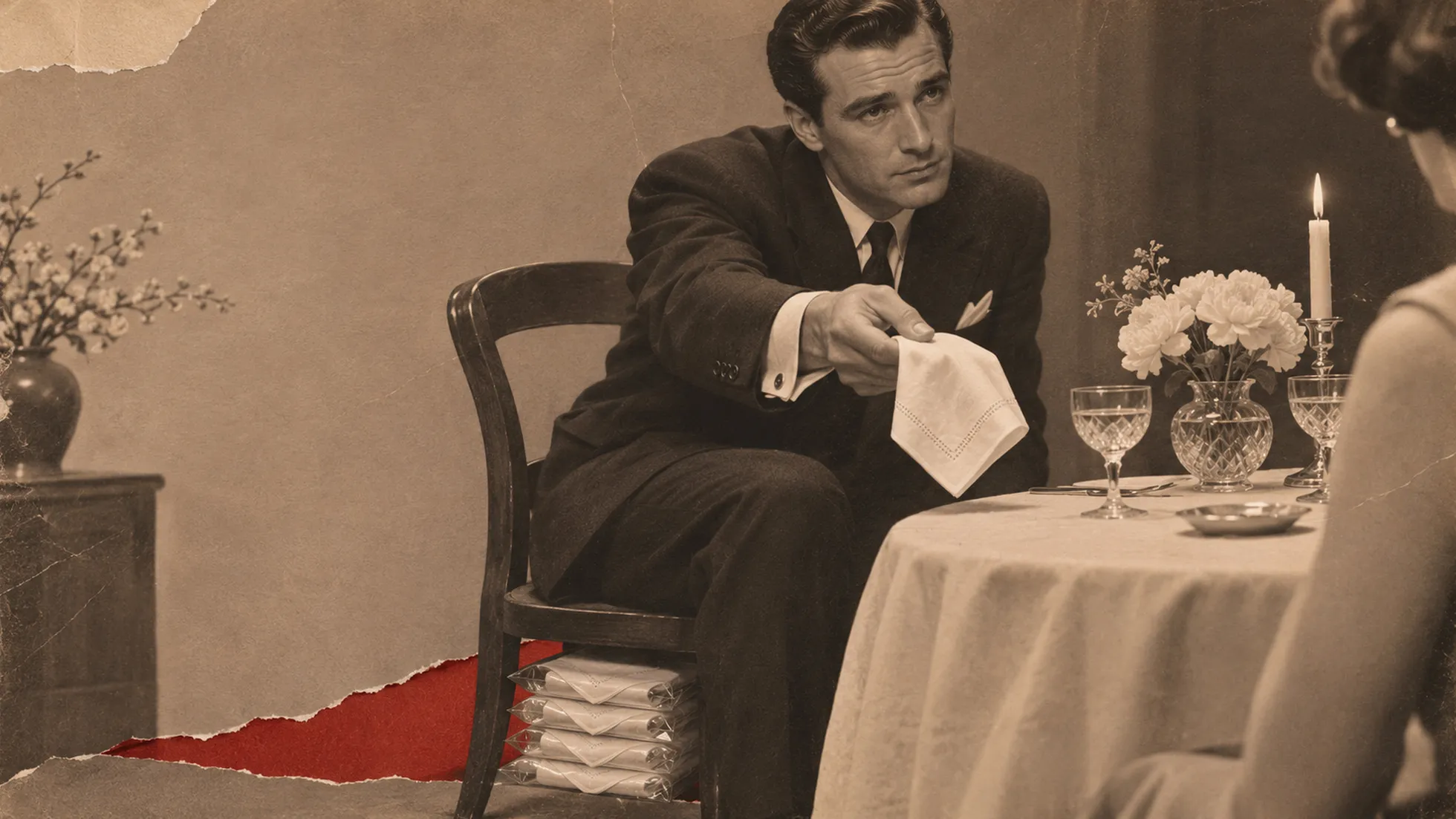
Case 09 · Filed 26 November 2026 · Amends: “He's apologised, and he's really doing the work.”
By the end of Tom’s apology, Nell was the one saying sorry.
It had taken 40 minutes. He read it from a notebook at the kitchen table on the Sunday morning, in the voice he used for the sixth form when they reached the good bit of Lear, and it ran to 11 pages in his small, careful hand. It began with his father. It moved, by way of a boarding school in Dorset and a therapist in Stoke Newington, to the previous Thursday, when he had switched off his phone and driven to a friend’s flat in Margate while Nell was under general anaesthetic having her knee looked at. The hospital would not let her go home without a responsible adult. She had sat in a reclining chair in a paper gown until 9pm, telling a nurse called Abi that her partner must have been held up, until Abi stopped asking and rang her sister instead.
Tom said that he had gone into shutdown. He said that he could see now that his shutdown had a cost, and that the cost had been carried by Nell, alone, in a paper gown, and he said “paper gown” with a small catch, because he had a gift for the detail that hurts. He said that what had happened between them was a rupture, and that he believed in repair, and that he wanted her to know, more than anything, that she had been — and Nell, who was looking at the fridge, knew before he turned the page that the next word was held.
“Held,” said Tom.
She cried, a bit. He cried more. And somewhere in the second hour, when he said how ashamed he was of the voicemail she’d left on the Friday morning, the one in which she had called him a coward and a child, Nell heard herself say that she was sorry for that voicemail. She shouldn’t have said child. It wasn’t fair. She knew he was working on it.
“Thank you,” said Tom, “for holding that.”
⁂
Within a week, the apology was the most admired thing in their circle.
They lived in Clapton, in a flat above a shop that had been a launderette and was now a launderette again, ironically. Their friends were the kind of people who say “I hear you” in restaurants. They had read the same three books about attachment, and they knew their own styles the way a previous generation knew their star signs. In that world an apology was not an embarrassment. It was a credential.
Priya asked to read it. She was training to be a psychotherapist and was, at the time, two years into the four-year course, the stage at which people can see everyone’s childhood from across a room. Nell said it was private. Priya said of course, totally, and then asked again on the Wednesday, and Tom said he didn’t mind, actually, if it helped anyone, and photographed the 11 pages on the kitchen table and sent them. Priya replied with a single heart and then, an hour later, a longer message saying she wished Dev could do even a fraction of what Tom did, and that Nell was so lucky, and that they really, really communicate. Dev was Priya’s husband. He had once apologised to her for forgetting her birthday by booking a restaurant that turned out to be closed.
“He’s so emotionally intelligentstruck out: emotionally intelligent corrected to: well read,” Priya said at the pub on Friday, and everyone agreed, and Tom, at the bar, looked modest in a way that took some effort.
Tom went, on Tuesday nights, to a men’s group in a church hall in Hackney Wick, where eight men in good knitwear sat in a circle and talked about their fathers. He took the Margate weekend there. He told them about the paper gown. The men held it, which is to say they nodded, slowly, and a man called Jonah who ran a pottery said, “That’s huge, man. That’s real accountability,” and Tom came home lighter than he’d been in weeks, and told Nell the group had been very moved, and Nell found that she was pleased. It was nice to be part of something that moved people.
She rang her mother in Stockport. Her mother asked whether he’d said sorry. Nell said he had, at great length. Her mother said, “Well, then,” in the tone of a woman checking a receipt.
“Your father never said sorry once in 41 years,” she added. “He bought a conservatory.”
This was true. It was the late 1990s. The conservatory was the size of a bus shelter and faced north, and Nell’s father had built it in the summer after something that nobody in the family had ever described, and had sat in it every evening afterwards, cold, as if it were a sentence he was serving. Her mother had never once gone in. The conservatory was still there, full of tomato plants and his golf umbrella. It had cost £6,000. It had not, as far as Nell could tell, contained a single word.
So when people asked Nell how she could stay with a man who kept switching his phone off — and people did ask, though not Priya, never Priya — Nell found it useful to think about the conservatory. Her father had built rooms. Tom built sentences. If you had grown up in a house where nobody ever named anything, a man who could talk about his shutdown for 40 minutes looked like the cure.
It was the sixth apology in four years. Nell knew the number without counting, the way you know the number of stairs up to your own flat in the dark.
⁂
Three weeks later, Tom did it again, with better vocabulary.
It was the weekend of her mother’s 70th. They were driving up to Stockport on the Saturday for lunch at a hotel near the station that served a carvery under a chandelier. On the Friday night Tom said he felt a bit flat. At 7am on Saturday the bed was empty and his phone went straight to the voicemail he had recorded during a happier period, in which he sounded like a man about to sell you a kayak. Nell took the 10.15 from Euston with a lemon drizzle cake on her knee, and told her mother that Tom had a migraine, and her mother said, “Has he,” and then said nothing at all for the rest of the carvery, which was worse.
He had been on Jonah’s narrowboat on the Lea. He came home on the Monday. The notebook came out on the Thursday.
This one was nine pages and noticeably better. It did not use the word “shutdown”, which he had come to feel was a bit passive. It used “dysregulated”, and “my nervous system made a choice my values wouldn’t have made”, and it said “I chose”, twice, which was new. It mentioned her mother by name. It quoted, without saying so, a line about repair from the book on Priya’s shelf. It contained the sentence “I will not leave you to carry my absence again,” which Nell thought was the best thing he had ever said to her, and which she would have felt more strongly about if he had not said a version of it in the March and in the October before that.
Then, on the Saturday, he did it again in public.
It was Jo’s 40th. Jo was Nell’s older sister and the only member of the family who had refused, on principle, to move to Hackney, in a terraced house in Leyton with a husband called Rob who fixed boilers and had never knowingly discussed an attachment style. Jo had booked the long table at the back of a Turkish restaurant on Green Lanes: 14 people, mixed meze, the lamb, and a cake hidden behind the counter with one candle in it, because Jo said 40 candles was a fire risk and also an accusation.
Tom waited until after the mains. He waited, in fact, until Rob had gone to the counter to arrange the cake, which nobody noticed at the time and which Jo noticed later. He tapped his glass. He said that he hoped Jo would forgive him for taking a moment of her evening, and Jo, who had not been asked and was not going to forgive him, said, “Go on, then,” the way you say it to a dog standing near something it might eat.
“I want to say something to Nell,” Tom said, “in front of people I trust. Because I’ve learnt that shame grows in the dark.”
He did not have the notebook. He didn’t need it. He had learnt it. He spoke for perhaps six minutes, standing, with one hand on the back of Nell’s chair, about the weekend of the 70th, and about his father, who had also disappeared at weekends, and about the person he was trying to become. He looked at Nell when he said “I chose”. He looked at the table when he said “accountability”. He had always known exactly where to look; it was what made him good with 17-year-olds.
Nell looked at her plate, as if checking it for errors.
Two of Jo’s friends from the council were crying. Priya, who was there because Priya was everywhere, held Dev’s hand under the table so hard that Dev’s face changed. A man from Jo’s work had got his phone out to film it, realised halfway through raising it what kind of thing it was, and put it face down on the tablecloth, where it went on recording the ceiling. Behind the counter, Rob and a waiter stood with the cake. The candle, lit too early, was burning down to the icing.
When Tom finished there was a pause, and then somebody clapped, and then three or four people clapped, softly, the way people clap at a christening, and Priya said, through her hands, that it was the braveststruck out: bravest corrected to: best-rehearsed thing she had ever seen a man do.
Then Jo said, “So what happens next time?”
She said it pleasantly. She was holding a piece of bread. She was genuinely interested; she was a housing officer, and in her line of work a promise was something you wrote down and checked in six weeks. But the table received it the way a table receives a phone going off in a theatre. Priya said, “Jo,” quite gently, as if Jo had wandered into a road. One of the council friends said that maybe this wasn’t the moment. Tom said, with enormous grace, that it was a fair question, and that he hoped the answer would be in what he did and not what he said, and that was so good an answer that people clapped again, as if he had done something.
And Nell — Nell, whose sister’s birthday it was, who had sat at a carvery alone with their mother a week earlier — stood up and put her arms round him, and said, into his shoulder, that it was all right. She was sorry she’d been so cold all week. Thank you, she said. Thank you for saying it here.
Then Rob arrived with the cake. The candle was a stub of blue wax in a small lake. Jo blew it out and did not make a wish, or said afterwards that she hadn’t.
At the end of the night the two sisters stood at the sink in Jo’s kitchen in Leyton, washing the glasses the restaurant had let them take home by mistake, and Jo said, without looking up, “They’re very well written, his apologies.”
In their family this was not a compliment. Nell dried a glass.
“Seriously,” said Jo. “It’s like he’s got an editor. Who’s his editor?”
Nell laughed, because it was funny, and said she should get home.
⁂
The notebook was always left on the kitchen table the night before.
It was an A5 notebook with a black cover and an elastic strap, the kind sold in stationers to people who intend to change their lives, and Tom kept it for what he called the work. On the night before an apology he would leave it open, at the new pages, with a pencil laid across it. He never said anything about it. He went to bed. And Nell, who was a copy-editor at a medical publisher, who had spent 15 years making doctors say what they meant and had never once been able to read a restaurant menu without wanting to fix its apostrophes, would make a cup of tea, sit down at the table, and pick up the pencil.
She had marked up all seven.
They were small notes, mostly. Professional ones. In the margins of the Margate apology, in her neat, sloped hand: Not “if”. Cut “I’m someone who”, it’s about you, not your brand. More on your dad here? Earns the ending. “Held” — fine, but you used it in October. He had kept “held”. She had known he would. On the Stockport apology: Say “I chose”. Twice. Mum’s name, not “your mother”. Is “dysregulated” you or Priya’s book? And at the bottom of the last page, a question she had meant as a challenge, in the way an editor writes a question when she means you don’t believe this: Would you say this in front of people?
He had taken it as a stage direction.
Neither of them had ever mentioned the pencil. That was the arrangement. In the morning Tom would read the apology to her at the same table, with her changes in it, as if every word had come to him in the night, and Nell would listen as if she had never seen it before. On the Thursday after Stockport he had reached I chose, which was hers, and looked up from the page, and his eyes were wet, and she had been moved. That was the strange part. She was always moved. Knowing where a line had come from did nothing to stop it landing. If anything it landed harder, the way a joke does when you have set it up yourself.
“She had never asked him to stop. Only to say it better.”
It had started in 2022, the first time, when he’d gone to his brother’s in Hastings for a weekend without telling her and come back with a two-line text that said he was sorry if she’d been worried. She had been so angry she couldn’t speak, so instead she had done the thing she was best at. She had printed the text out, at work, on the big printer, and gone through it with a red biro, the way she would a contributor who had sent in something lazy, circling the if, writing worried is not the word in the margin, and who are you apologising to? — and she had left it on the table, as a cruelty, the way you leave a parking ticket on a dashboard.
The next day he came back to her with a page of his own, rewritten. It was better. It was much better. It took her corrections and went beyond them. He read it to her in the kitchen, and she forgave him, and that night was the best night they had had in a year. That was the trouble. It had worked. Without either of them saying so, the next one arrived on the table in draft.
She had switched from red to pencil in 2023, because red felt hostile.
What she had done, over four years, was this. She had taught him, sentence by sentence, how to apologise to her: in what order, with which details, how long to stay on his father and when to come back to her. She did not give him the words. The words were his, or the therapist’s, or the men’s group’s, or the book’s. She gave him the order. She cut his self-pity and his hedges. She asked for specifics. Twice she had changed I’ll try to I will, and both times he had read it back to her with tears in his eyes, and both times it had been a lovely moment, and neither time had she checked.
Because in four years of margins, seven apologies’ worth of patient, professional pencil, she had never once written Don’t go.
⁂
This is the point at which a certain kind of reader relaxes. The man with the beautiful apologies had a ghost-writer; the ghost-writer was the woman he kept leaving; so she was in on it; so — the sentence nearly writes itself — she brought it on herself.
She didn’t. Tom left. He left her in a paper gown until 9pm and at a carvery with a lemon drizzle; he left, each time, with his phone off and his car keys in his hand, and nobody edited that. Whatever else is true, that is the first true thing. The reader who is relieved to discover that the wronged woman is also somehow responsible has found a cheap way of not having to think about the man, and it is a very old way.
But the apology was not for nothing. It was doing a job for her, and it is worth being exact about which.
It was the thing her father had never given her mother, and she had grown up wanting it the way other children want a dog. A good apology, from a man, out loud, with the details right, felt to her like being loved properly at last. She was not wrong about that. She was only wrong about what it proved.
It was also the best hour of the month. Tom was a distracted man, with a phone and a men’s group and 150 teenagers, and the morning of an apology was the one morning he looked at her for an hour without looking at anything else. A woman can grow fond of the morning after. She can start, without ever deciding to, to arrange her life around it.
And it was, above all, the version of events. Their friends knew Tom disappeared. Half of Clapton knew. As long as the apologies were good — as long as Priya asked for copies and the men in knitwear said “huge” — Nell was not a woman whose boyfriend kept vanishing. She was a woman in a relationship that was working on itselfstruck out: working on itself corrected to: being written up. Her staying didn’t look like weakness. It looked like grace. Every edit made the apology better, and every better apology made her staying easier to explain, and an apology that good needed something to apologise for.
None of which means Tom was faking. That is the part his critics would get wrong. He meant it, every time. He wept real tears in the kitchen and at the restaurant, and on the boat he probably wept as well. He went to his therapist at £75 a week and his men’s group every Tuesday and he believed — as most of us would, with that much evidence — that a man who could describe his patterns this precisely must be changing them. He was not using the vocabulary as cover. He was using it as a substitute, which is harder to spot, especially from inside. And being edited, for him, was its own kind of being looked after. Somebody read every word. Somebody cared enough to want it better.
So they had built, between them, a small and efficient factory, and it produced the most admired thing in their circle, and it ran on the one raw material neither of them would admit to ordering: another weekend.
It is tempting, from outside, to think that you would have seen it. Most of us have stood at a table like Jo’s, or read a statement like Tom’s — from a friend, a colleague, a man on the news with a careful jumper and a careful paragraph — and judged it, mostly, as prose. Was it specific? Did it say if? Did it centre the right person? Most of us are editors of other people’s remorse now, and quite good at it, and we have almost no way of grading the only thing that matters, because the thing that matters is what happens on an ordinary weekend when nobody is watching and nothing gets said. An apology has an audience. Change doesn’t. It just looks like nothing.
⁂
The second knee was done in February.
The letter from the hospital asked, as before, for the name and number of a responsible adult who could take her home and stay for 24 hours. Nell sat with the form at the kitchen table, next to the notebook, which was closed, and wrote down Jo’s name.
She didn’t tell Tom the date. She didn’t do it to test him, or to punish him. She did it, she would decide later, because she did not want to have to forgive anyone. She was tired of forgiving. It was a lot of work, and she had been doing it to a very high standard.
Jo collected her at 4pm. She came in Rob’s van, which smelled of flux, and drove her back to Clapton at 20 miles an hour with the radio on, and asked if she wanted a tea, and made one, and then sat on the sofa and read the Metro and complained about the council for three hours. It was the least interesting afternoon of Nell’s year. Nothing happened. Nobody went anywhere. Nobody would ever ask to read it.
Tom came home at 6pm and saw her leg up on the cushion and understood, slowly, the way he understood most things that weren’t in a book.
“You didn’t tell me,” he said.
“No.”
“I’d have come.”
“I know,” Nell said, and found that she half believed it, which was more than she’d believed in a while. “I just didn’t want to find out.”
He stood in the doorway for a long time. Then he went to the kitchen, and she heard the elastic on the notebook, and the chair scrape, and the pencil. She waited. Nothing. After 20 minutes she went in. He was sitting at the table with the notebook open at a clean page and the pencil in his hand, and he had not written anything, because for once there was nothing to apologise for, and he did not know how to begin.
Nell sat down opposite him. Out of habit she reached for the pencil. Then she put her hand flat on the table instead.
They sat there until it was dark. For once, neither of them said sorry. It was the most honest evening they’d had in four years, and there was nothing in it that anyone would have asked to read.
Nobody asked to read it.
End- Filed under
- Private Lives
- Form
- Dramatised
- Length
- 3,774 words
- First published
- 26 November 2026
- Got something wrong?
- Write to us