Case 01 · Filed 26 November 2026 · Amends: “I built it from my kitchen table.”
The keynote speaker at the Independence Summit wore white trainers with her suit, which is how you know someone has never had to choose between the two. She walked on to music at 9.30, waited for the applause to settle, and told 800 people that the greatest mistake of her early career had been waiting for permission.
It was a good line. People wrote it down. In the fourth row, Grace wrote it down too, on the back of the parking receipt she would need at the exit, because the summit had cost her a day’s leave and the car park had cost her the rest of the week’s lunches. The ticket itself had been a birthday present.
Never depend on anyone, the speaker said, and she meant it.struck out: meant it. corrected to: believed it.
Her name was Philippa. She was 44. She had built a company that sells very expensive bedlinen to people who already own bedlinen, and she had built it, as the programme put it and as she put it twice in the first 10 minutes, from her kitchen table. What the story did not mention, because stories rarely mention furniture, was whose kitchen it was, who had paid for the table, and who collected her children at 3.15 while she was busy refusing to wait for permission.
Several of the people who could have answered those questions were in the building. Her husband, Dominic, was in the front row, in a seat with his name on it. Her driver, Stuart, was in the car park, two bays from Grace, with the engine running for the heater. And her father, Malcolm, who was 78, sat at the back by the fire exit, because he did not like a fuss, or rather he liked a fuss very much and did not like to be seen enjoying one. When the speech ended and 800 people stood up, he was the only person in the hall who stayed in his seat.
⁂
Follow the money and you meet the family, one relative at a time.
The kitchen was in Richmond, and it belonged to her parents. Philippa moved back into her childhood bedroom in 2013, at 31, with a box of samples and a business plan, and stayed for two years. She paid no rent. Her mother did her washing, which is not in the speech either, though it is hard to build anything from a kitchen table if you are also doing the ironing on it.
The table was paid for, in a sense, by Malcolm, who lent her £80,000 that autumn on terms that were never written down, which is the most expensive kind. It has not been repaid. It has not been mentioned. It is discussed at every Sunday lunch, in other words: in his questions about margins, in his views on the autumn range, in the way he says “your company” with the faint stress of a man who is too polite to say “our”.
Dominic arrived in 2016. He is a tax barrister, and for four years his salary paid the mortgage, the nursery and the holidays, while Philippa paid herself nothing, a fact she mentions often, as though nobody had been paying her instead. Kerry arrived in 2018, at £16 an hour, 50 hours a week, and has collected the children, from nursery and then from school, at 3.15 every weekday since, which is what made it possible for their mother to be photographed, so often, at her kitchen table, at 3.15.
Stuart came last, with the second round of investment. He drives her to things like this. He would wait four hours in an east London car park, eat a meal deal at 11.30, and drive her to a lunch in Mayfair at which she would say, again, that she had never waited for anyone.
“There is a peculiar kind of wisdom that becomes available once somebody else has settled the bill.”
None of this makes her a liar. She did work hard. She did take risks. She simply took them in a building with very good scaffolding, and then gave a talk about climbing. The programme described her, without irony, as self-madestruck out: self-made corrected to: self-assembled, from parts supplied by others.
And the summit itself had a budget, which nobody on stage mentioned either. Tickets were £195. Eight hundred of them had been sold. Philippa’s fee that morning was £15,000, which means that the first 77 people through the door had paid for her to tell all 800 of them not to depend on anyone. Grace’s £195 was somewhere in the other 723, paying, as far as she could tell, for the coffee. But the principle held. Somebody in the hall had always been paying for the speech. It just had not been the speaker.
⁂
The questions began at 10.15. A woman called Jules, who hosts a podcast about founders, walked out with a handheld microphone and the bright, urgent manner of a person who has been told the session is overrunning.
The first question came from a man in a gilet, who wanted to know how Philippa had thought about scaling. Philippa said she had thought about it a lot. The man nodded as if a debt had been settled.
The second came from a young woman near the front, who stood up, took the microphone with both hands, and asked the only question anyone in the hall had come to ask.
“How did you pay your rent? In the first two years?”
There was a small movement in the room, the kind a congregation makes when someone mentions the collection.
Philippa smiled. She had been asked before. “I didn’t,” she said. “I moved back in with my parents. I was 31, all my friends were buying flats and getting engaged, and I was in my childhood bedroom with a box of pillowcases. I gave up everything.”
Someone began to clap. Then several people did. Then the hall applauded, warmly and at some length, the two years she had spent living rent-free in a five-bedroom house in Richmond.
“That’s the sacrifice nobody sees,” said Jules, and the hall clapped again, for the sacrifice nobody sees, which they had now seen twice.
The young woman sat down. She looked, Grace thought, like a person who had asked the price of something and been told it was priceless.
The third question came from a woman with a lanyard from a bank, who did not have a question so much as a thank you. “I just want to say,” she said, “thank you for being so real.” Philippa put her hand on her heart. The hall made the noise halls make when somebody is being real. In the front row, Dominic, who had paid the mortgage on the reality for four years, looked at his phone.
Grace had her hand half up. Her question was written on the parking receipt, under Never depend on anyone. It said: Who lent you the money? She held it there for some time, at the height of a person stretching, and then the session was overrunning and Jules thanked everybody, and Grace put her hand down and used it to applaud.
Afterwards, in the corridor, among the tote bags, Malcolm found his daughter and kissed her on the cheek.
“Good speech,” he said. “Better than Manchester.”
⁂
Consider two founders with the same idea.
The first describes leaving her salaried job as the bravest thing she has ever done, and in a sense it was. It is brave to jump. It is somewhat less brave when your father has already measured the drop and laid a mattress at the bottom.
The second founder has the same idea, the same spreadsheet and two children who insist on eating every day. She does not jump. Years later, from a stage, the first founder will tell her, kindly, that the difference between people who make it and people who don’t is mostly courage.struck out: courage. corrected to: a parent with savings.
Grace is the second founder, more or less. She is 39 and runs operations for a firm that leases office furniture. In 2014 she had an idea for school uniform that children could grow into, and the spreadsheet is still on her laptop, in a folder called Plan B, in a file called Plan B FINAL (2). She opens it every January. She has never told Philippa about it, and never will, because Philippa has never met her, and because the only people who hear about the businesses that weren’t started are the people married to them.
So far, so comfortable. This is the essay a reader of this publication could write in their sleep, and has perhaps already written, in a group chat, about somebody else. Nobody is self-made. Look for the parents. Look for the house. The founder myth is privilege with good lighting, and we, who know this, are not fooled.
But the fear was real. It is worth saying that plainly, because the comfortable version prefers not to. In the winter of 2015 the bedlinen company was six weeks from closing. A supplier in Portugal had gone under with a container of her stock in it; the bank had declined her; she had done the VAT return at 2am at the kitchen table, her parents asleep upstairs, and been sick in the downstairs lavatory, quietly, so as not to wake them. The mattress was there. She could not see it from where she was standing. Nobody ever can. Fear does not check your bank balance before it arrives, and she did lie awake, and she did put her name on things, and the company she built employs 64 people, all of whom are paid on time. You can believe in the scaffolding and still notice that someone climbed it.
Her fear was genuine. So was the mattress. The trouble with the comfortable version is that it is also a story, and it has a budget too. If success is only a parent with savings, then Grace did not fail to jump; she was never offered the drop. That is a kinder story for Grace. It is, for the price of a ticket, a very kind story for all of us.
⁂
Manchester was in 2019.
It was a breakfast for women in business at a hotel near Piccadilly, 120 people, a fee of £1,500, and Philippa, who was not yet anybody, told the whole thing. She had decided to. She had been reading, that year, about privilege and luck, and had concluded, with the zeal of the newly informed, that the honest thing was to show her workings. So she did. The bedroom in Richmond. The £80,000 from her father. Dominic’s salary. Kerry, by name. She ended by saying that she was proud of what she had built, but that it would be dishonest to pretend she had built it alone, and that anyone in the room who was doing it without a safety net was braver than she had ever had to be.
She sat down to polite applause and a plate of cold eggs.
The feedback forms came back a fortnight later, in a spreadsheet from the organiser. Her average score was 2.3 out of five. The comments field was short and frank, in the way of comments fields everywhere. Not relatable. Felt like a humblebrag. Would have liked more on mindset. And one, which she can still recite, from somebody who had paid £35 for the breakfast and evidently felt short-changed: Must be nice.
She sent the spreadsheet to her agent. Her agent, Saskia, who represents a number of people who speak at things, rang her back within the hour and gave her the most commercially valuable advice of her career.
“Lose the dad,” said Saskia.
So she did. The next year the father went, and the speech scored 3.9. The year after, the bedroom in Richmond became her kitchen table, which was technically true, and the score went up again. Dominic was promoted to her rock. A rock. An extraordinary promotion: from unpaid infrastructure to geological feature. Kerry left the speech entirely, so smoothly that Philippa could no longer remember the year she had last been in it. The opening line changed from “I had a lot of help” to “I started with nothing but an ideastruck out: an idea corrected to: £80,000 and an idea”. Her fee went from £1,500 to £4,000 to £9,000 to £15,000. The speech improved the way a garden improves when you stop letting people see the shed.
Which is the part of the story the comfortable version has to leave out. The self-made founder did not invent the self-made founder. She tried the other one first, and the market sent it back.
Who writes Must be nice? Not, in the main, people with mattresses. It is written by people who paid £35 for breakfast and wanted a reason to believe it might work for them, and by people who were already sure it wouldn’t and wanted confirmation, and by people who are simply tired of being told about other people’s fathers. It is written, if you will forgive the observation, by you. Not on a feedback form, perhaps. But you have a word for the founder who admits the loan, and the novelist who admits the agent was a family friend, and the actor whose surname you recognise, and the word is not “honest”. It is a word you use in a group chat, and it rhymes with “depot”, and it is the reason nobody tells you the truth in public. We say we want the whole budget. When we get it, we mark it 2.3.
And there is the other ledger, the one in your own drawer. The deposit on the first flat, which you describe as “saving”. The year in your aunt’s spare room in Kentish Town that made the unpaid internship possible, which you describe as “the internship”. The partner whose salary covered the MA, who is now, in the story of the MA, a rock. Nobody asks you to give a keynote. You tell the speech anyway, at dinner, in the same order and with the same omissions, because you have also tried the other version, and you saw people’s faces.
⁂
It would be very satisfying to stop there, with the audience convicted and the speaker released on appeal. It would also be wrong, and the person who would tell you so first is the man by the fire exit.
Malcolm hated Manchester. He had heard about it from a friend of a friend, which is how men of 78 hear about everything, and he rang his daughter that evening and said, with the coldness he reserves for waiters and people who say “going forward”, that he had not lent her £80,000 so that she could tell a hotel full of strangers about it. He was not embarrassed for her. He was embarrassed for himself. A loan you announce is a loan; somebody might ask when it will be repaid. A loan nobody mentions is something else entirely: a gift in public and a debt in private, an open account, a permanent seat at Sunday lunch from which to ask about margins. He did not want thanks. Thanks would close the account. So when 800 people stood up for his daughter’s courage, Malcolm stayed in his seat and listened, as he has listened to every version since, for his own name, the way a man reads a bank statement; and when he did not hear it, he relaxed. Better than Manchester was not praise. It was a receipt.
Philippa, who began by leaving her father out because the market told her to, has told the new version so many times that it has become the true one. She does not, at 3am, remember the mattress. She remembers the VAT return and the downstairs lavatory, and they are real, and they are hers, and they are the only part of the story nobody else paid for. This is how a sentence moves from meant it to believed it: not by a lie, but by repetition and applause. She is entirely sincere now. Sincerity is remarkably affordable when 800 people a morning are paying for it.
And Grace needs it too, which is the hardest part. Grace did not come to the Independence Summit to hear that the difference between her and Philippa was £80,000 and a house in Richmond. She could have got that for nothing, from her own bank statement. She came for the other version: the one in which the difference is courage, because courage is the only item on the list she could possibly acquire by Monday. The honest version is fairer, and it gives her nothing to do. The self-made version is a lie, and it comes with a to-do list. Nobody sells tickets to the first one. Of all the things on sale in that hall, the tote bags included, the lie was the only one that came with a future.
⁂
At 1pm, the car park was emptying of the people who had somewhere better to be. Stuart had the engine running and a meal deal on the passenger seat, the sandwich eaten, the crisps saved, which is the arrangement of a man who knows exactly how long four hours is. Philippa came out through a side door with Dominic and got into the back of the car without looking at the bays on either side, which is not rudeness; it is simply what you do when you have never had to find your own car. The woman in the white trainers had had to choose between two things after all, once, in Manchester. She had chosen the one that sold.
Two bays along, Grace was leaving too. The afternoon sessions were included in the ticket, and one of them was called Building Your Support Network, but the children came out of school at 3.15 and there was nobody else to be standing at the gate when they did. At the barrier the machine took her parking receipt, the one with Never depend on anyone on the back and Who lent you the money? underneath, and charged her £32 for it, and gave it back stamped. She put it in the glovebox, with the others.
The ticket for the summit had cost £195, and it had been a birthday present from her mother, who is 71 and lives in Leyton and gives presents in envelopes. The card had said, For your ideas. Mum x. Grace had not told anyone at work. She had not mentioned it at the summit either, at the coffee, when the man in the gilet asked her what she did and she told him about Plan B, for the first time in years, out loud, to a stranger. She had said she was thinking of going for it. She had said she would be doing it on her own.
And if she does, one day, and it works, and she stands on that stage in white trainers of her own, she will leave her mother out. She will leave out the envelope, and the spare room if it comes to a spare room, and the husband who covers the mortgage while she pays herself nothing. She will tell 800 people that the greatest mistake of her early career was waiting for permission. And we will clap, all of us, the ones who know better loudest, because it will be such a relief to hear it from somebody who sounds like us.
Somebody is usually paying. Grace wrote the question on the back of a receipt and kept it in the glovebox, where it is safe, and where nobody, least of all Grace, will ever have to answer it. It is the same question nobody asks of the speech, or the eulogy, or the story you will tell tonight about how you got where you are.
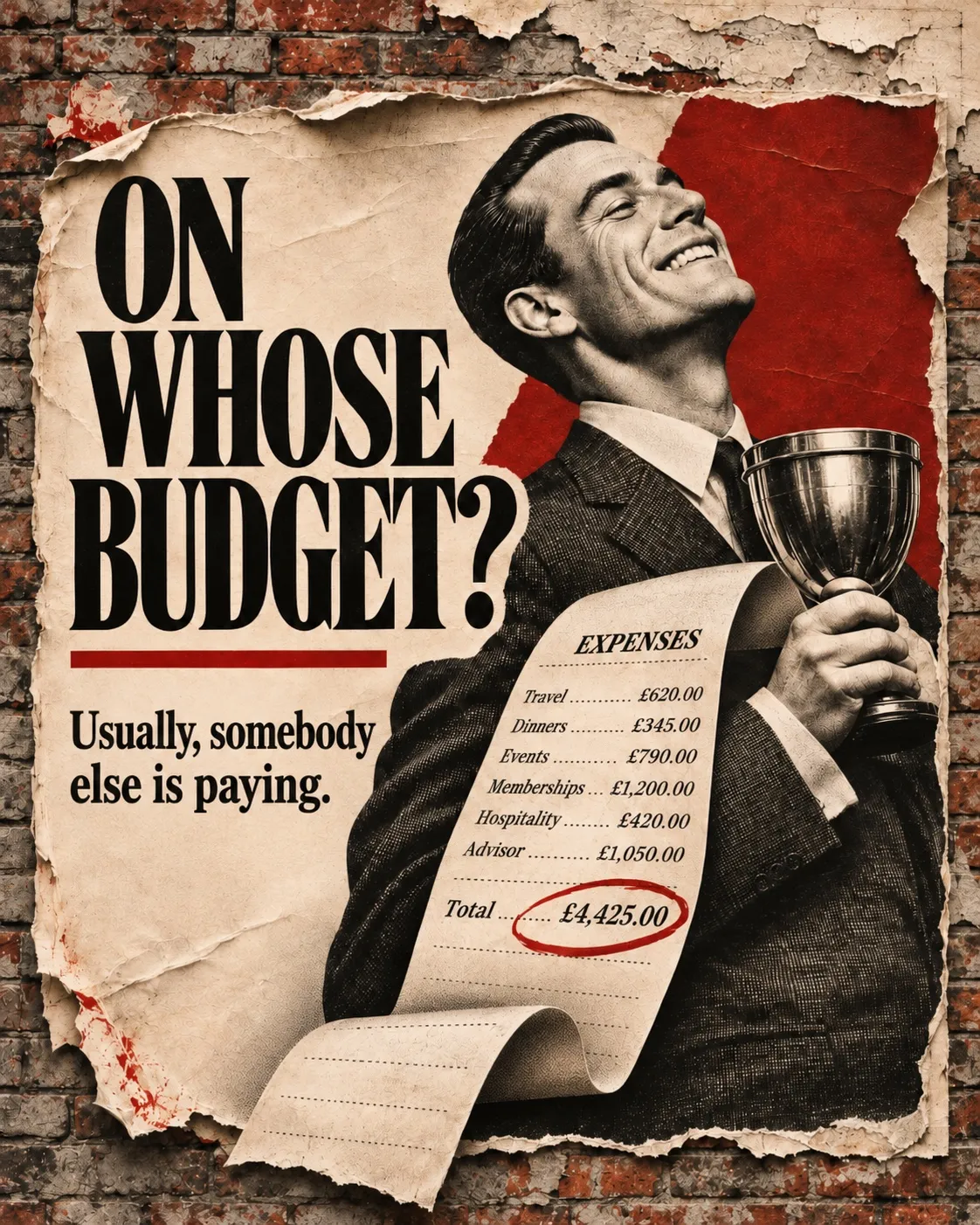
On whose budget?
We paid for the edit.
End- Filed under
- Public Virtue
- Form
- Composite
- Length
- 3,265 words
- First published
- 26 November 2026
- Got something wrong?
- Write to us