Case 21 · Filed 26 November 2026 · Amends: “3.15pm. Dad: a few words.”
Owen had booked his father’s change of heart for 3.15pm, between the salmon and the cake.
It was on the running order, which he had typed, printed and laminated, because the forecast said 40 per cent and paper goes soft in the damp. 12.30, arrivals and Pimm’s. 1.15, lunch. 2.45, Terry (if he insists). 3.15, Dad: a few words. 3.30, cake. 4.40, Claire’s train. The sheet hung on the kitchen door from a magnet shaped like a lighthouse, where Jo had read it at seven that morning and said nothing, which in a marriage of 26 years is a paragraph.
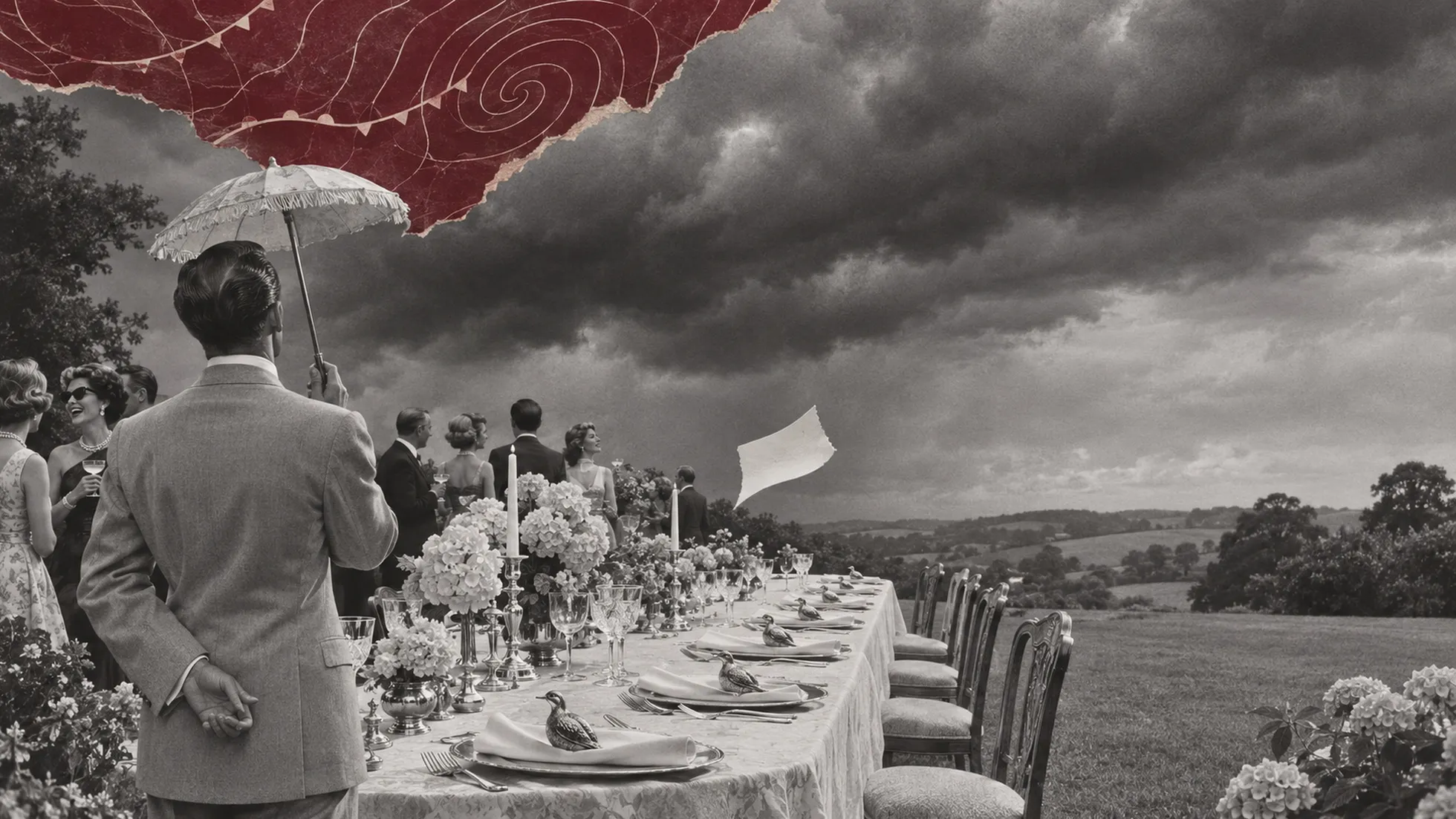
Outside, the table ran the length of the garden to the back fence, beyond which a farmer’s field rolled off towards the Weald under a sky the colour of a filing cabinet. Twenty-two places. Twenty-two linen napkins, ironed into triangles. On each napkin, to stop it leaving, sat a small ceramic bird: a partridge, a quail, a thrush, a wren, bought as a job lot from a garden centre in Paddock Wood at £3 each, because a man on Radio Kent had used the word “gusty”. Owenstruck out: Owen corrected to: Jo had laid the table. Owen had had views on it.
He checked the Met Office app at 11.02. Forty per cent at three. Sixty at four. He checked it again at 11.04, as if the sky might feel watched.
His father was turning 80. Owen had been waiting for this for eight years, and in another sense for 41.
⁂
Here is how Frank described Tuesdays, to the pharmacist, to the waitress at the Harvester, to Terry at the Legion: “Owen pops round.”
Here is a Tuesday. At 9.10 Owen left the council offices in Tonbridge, where he had worked in planning for 19 years and where his line manager had long ago stopped asking why he was never in on Tuesday mornings. He collected the prescription: 11 tablets a day, which he sorted at the chemist’s counter into a plastic box with a lid for every day of the week, because Frank, left to himself, took Thursday’s on Monday to get it over with. At 9.40 he let himself into the flat in Tunbridge Wells. He emptied the fridge of whatever had gone off and replaced it with the same things, which would go off by the following Tuesday, because Frank bought nothing and ate less. He took the bins down, because collection was Wednesday. He sorted the post into a pile Frank called “the admin” and Owen called “the post”. Then he drove his father to Tesco, walked him round it at the speed of a state funeral, and drove him to the Harvester for lunch, where Frank paid, every week, with a ceremony, for two gammon and eggs. The bill came to £23 and a bit. Frank always left the bit.
Once a month there was the GP, and once a quarter the optician, and once a year the man about the boiler, who would talk only to Frank and look only at Owen. By three Owen had dropped his father home and was back at his desk, where he worked until seven to make up the hours.
Frank’s version took two words. Owen’s took the whole day, and the evening, and, if you asked Jo, a fair amount of Sunday.
It had not always been like this. For most of Owen’s life there had been no Tuesdays at all. Frank had left in the spring of 1985, when Owen was 11 and Claire was 14, for a woman called Lorraine who worked at the Halifax on the high street, so that for several years their mother could not pay in a cheque without being served by the reason. He took the car and the good record player. He sent birthday cards with a £10 note and the wrong age.
Access was alternate Saturdays at ten. Owen had his coat on by half past nine, and sat on the stairs where he could see the road through the glass in the front door, with a carrier bag of things to show his father: a model, a school report, once a list of things they might do, numbered. Frank came, over the three years before he stopped coming altogether, roughly one Saturday in three. On the other two, at about half past eleven, their mother, June, who raised them on a school secretary’s salary and a small set of sayings, would come and sit on the stair below him and say the one she saved for this: “You can lay the table, love. You can’t own the weather.” Then she would take him to Woolworths, which was not the same, and which they both pretended was.
June died in 2017. The following spring Lorraine left Frank for a man with a boat in Whitstable, and Frank, who was 72 and had never in his life paid a gas bill without a woman telling him to, rang his son. Not his daughter. Claire, he said, was very busy, which was Frank’s word for a door he knew to be shut.
Owen went round the next Tuesday. They went to Tesco. It was, Owen said later, when Jo asked, uneventful.
He had never asked his father for anything, and he was proud of that. Asking would have spoiled it. What Owen wanted could not be requested; it had to be offered, freely, at the right moment, in front of the right people, or it didn’t count. So he gave eight years of Tuesdays freelystruck out: freely corrected to: on account, and he waited, and he kept a contract nobody else had signed. Its terms were simple. One day his father would see. One day, at a family table, with Claire there, who had been right about him, and Jo there, who had been patient about him, Frank would stand up and say that he had been a poor father, and that Owen had been a better son than he deserved. Owen had imagined the scene so often that he had begun to edit it.
He had settled on the 80th the way other people settle on a retirement date. Eighty, he told Jo, was when a man starts doing his accounts.
“Is it,” said Jo.
⁂
Claire came first, off the 12.04 at Tonbridge, down from Clapham, in sunglasses, though there was no sun to speak of. She had not been in a room with their father since their mother’s funeral, at which Frank had sat in the third row next to Lorraine and wept more loudly than anyone, which Claire had never forgiven, on the grounds that it was the first thing he had done for June in public in 32 years.
“I’m here because you asked,” she said, kissing Owen on the cheek and looking down the table. “Who are the birds for?”
“The wind.”
“Of course they are.”
Frank arrived at 12.50 in a taxi Owen had booked and paid for in advance, wearing a blazer with brass buttons and the expression of a man arriving at a party in his honour, which he was. He came up the side path without the stick he used on Tuesdays. Behind him, holding his arm, came a woman nobody had ever seen.
“This is Pat,” said Frank.
Pat was 74, in a lilac jacket, and delighted to meet everyone. She and Frank had met at the tea dance at the church hall in Tunbridge Wells, which ran on Tuesday afternoons from 3.30. They had been partners for two years.
“He’s ever so light on his feet,” Pat told Jo.
Owen, who every Tuesday at 3pm helped his father out of the passenger seat of a Skoda by the elbow, the way you’d lift a sideboard, said that was lovely. Then he went inside to the running order, as if it might have been updated, and came back out and gave Pat his own place, and stood. He had meant to stand anyway. A host who sits down is a host who has stopped noticing things.
Lunch went as lunches go when the guest of honour has had two Pimm’s and a story about himself for every course. Frank held the end of the table. He told the one about the depot. He told the one about the Ford Capri. He complimented Owen loudly on the salmon, which Jo had poached at six that morning, and Owen said thanks, Dad, and Jo said nothing, the way she had said nothing to the running order. He asked Claire, at a volume designed to carry over the hedge to the neighbours, whether “that husband of yours” was still in the house, and when Claire said the divorce had been final for three years, Frank said, “Good. Never liked him,” and raised his glass to her as if they had agreed on something.
Terry, from the Legion, did not wait for 2.45. At 2.10, between the new potatoes and a second wave of Pimm’s, he stood, tapped his glass with a fork until the fork bent slightly, and began.
“I’ve known Frank 51 years,” said Terry. “Fifty-one years. Drove the 402 together out of the Tunbridge Wells depot, and I’ll tell you this for nothing, there was never a man in that depot who could get a double-decker down Mount Pleasant with his elbow out the window and a fag on like Frankie.” Applause. Frank raised a modest hand. “Darts. Captain of darts. Never once bought a round he could get somebody else to buy.” Laughter. “And the ladies,” said Terry, and here Jo, who had been at enough of these, put down the serving spoon. “Because Frankie, and I think he’d want me to say this, Frankie was a romantic. Sixteen years married, and one day he goes into the Halifax to pay in his wages, and there’s this girl behind the glass, and he’s gone. Gone. He opens a savings account just so he’s got a reason to go back in. Opened three in the end. He had the best-saved wages in Kent.” Terry did the voice of the girl behind the glass. He did Frank’s voice, asking about interest rates. “And the rest,” said Terry, finding June’s son and June’s daughter at the table and raising his glass towards them with real warmth, “is history.”
Several of the guests laughed. Pat laughed, uncertainly, like someone who has just been told which chapter she is in. Claire laughed loudest of all, at a slightly wrong moment, and went on laughing a little after everyone else had stopped, which is the cruellest thing you can do to a man telling a story at a party. Terry sat down. Frank said, “Thank you, Tel,” and seemed genuinely moved. Owen, who had been standing at the far end of the table holding the Pimm’s jug, discovered that he had been holding it level throughout, and that not a drop had gone, and was briefly, absurdly proud of this.
The app said 70 per cent at four.
At the shed, while Jo brought out the pudding plates, Claire found Owen checking it again.
“What’s at 3.15?”
“Dad’s saying a few words.”
“Is he.”
“I asked him to.”
Claire took off her sunglasses for the first time. “Owen. What do you think he’s going to say?”
Owen didn’t answer, which was an answer.
“You think he doesn’t see it,” Claire said. “All of it. The pills and the bins and the Harvester. That’s the thing you’ve got wrong for eight years. He’s not blind. He’s the least blind man I’ve ever met. He sees exactly what you do. He just thinks you want to.”
“I stopped waiting for him in 1991,” she added. “It’s very restful. You should try it.”
“He rang me,” said Owen. “Not you.”
“Yes,” said Claire, putting her sunglasses back on. “Ask yourself why.”
At 3.15 Owen tapped a glass. He walked to the end of the table, under his mother’s lace parasol, which he had found in the loft that morning and been holding over the cake on and off since, because it was the only object in the house with any relationship to the sun. He handed his father an envelope.
Frank put on his reading glasses. He opened the envelope and took out a white card and read it. He read it for long enough that the table went quiet, and then quieter, and somewhere up the field a crow said something about it. Then he took his glasses off, laid the card face down by his plate, and stood.
He thanked Pat, who had taught an old dog the cha-cha. He thanked Terry, for everything except that story. He thanked Jo for a lovely spread. He thanked “my daughter Claire, who has come all the way from Clapham”, a journey of under an hour, as if she had crossed the Andes on foot. He raised a glass to June, who, he said, would have hated all this, and everyone laughed, because it was true. And then he turned, and found his son at the end of the table under the parasol, and smiled at him with real fondness.
“And Owen,” said Frank, “who likes to keep busy.”
There was applause. Glasses went up. On every napkin a bird held its ground. The card by Frank’s plate, the one piece of paper on the table that nobody had thought to pin, lifted at one corner, turned over, rose, cleared the hedge, and went off across the field into the weather.
⁂
Owen went after it. People assumed, he discovered later, that it was a place card, and that he couldn’t bear an untidy field.
It came down about 60 yards out, in the wet grass by a water trough, face up. The first drops of rain were arriving. He stood over it with the parasol, which did nothing, and read it again, though he knew it by heart, because he had written it.
I want to say something I should have said a long time ago. I wasn’t a good father to Owen and Claire. I left, and their mother did everything. And for the last eight years Owen has done everything for me, every Tuesday, without a word of complaint, and I have never once thanked him. (Pause.) So: thank you, son. I’m sorry. You were a better son than I deserved. (Raise glass.)
It was in Owen’s handwriting, in the fountain pen he used for condolence cards. It was the 11th draft. The first had run to two sides and included Lorraine; he had cut her for tone. He had given it to his father in an envelope, at the table, at the scheduled time, because handed over the week before, in the flat, the card could have been refused, and handed over in front of 22 people it couldn’t. He had believed, in a part of himself he did not visit on weekdays, that if the words were put into his father’s hand in front of witnesses, his father would say them, and that once they were said aloud they would become true, the way vows do.
It had said on the running order, 3.15pm, Dadstruck out: Dad corrected to: Owen: a few words.
So that was the arrangement, seen from the field. Not a son waiting for a father to change, but a son who had drafted the change, cut it for length, rehearsed the pauses and booked a slot for it, and who now stood in a wet field holding his dead mother’s parasol over a card his father had declined to read aloud. You could call it control. You could call it hope with a laminator. The rain was coming on properly now, and the guests were carrying plates into the house, and nobody was looking at him at all, which is the other thing a host who never sits down is arranging.
Frank came down the field ten minutes later, under Pat’s umbrella, without the stick.
“I can read, you know,” he said.
“I know.”
“Fountain pen. Very nice.” Frank looked at the card in the grass and did not pick it up. “I said it, son. Years ago. You remember.”
Owen did remember. It was the first Tuesday, in 2018. The Tesco car park, by the trolley bay, with a bag of shopping between them in the rain. His father, who had been quiet all the way round the aisles, had said, without any preamble, looking at the trolleys: “I’m sorry, son. For all of it. Your mum. Everything.” And Owen had said, “Not here, Dad.” And then, “Let’s get you home.”
He had driven back along the A26 with a feeling he had decided, on the spot, not to look at too closely, and the feeling was relief. Because an apology in a car park settles the account in one go, with nobody watching, and then there is nothing owed. And a son who is owed nothing is only a man doing his father’s shopping on a Tuesday, which is what other people’s sons do, and nobody writes them a card about it. The debt had been the best thing Frank ever gave him. It turned eight years of bins into a cause, and his patience into a position, and his Tuesdays into the one place he had ever been more important than Lorraine. He hadn’t wanted the payment. He’d wanted the bill.
“Likes to keep busy.” It had been the most accurate thing anyone said all afternoon.
“Why didn’t you read it?” said Owen.
Frank considered the field.
“If I’d read that out,” he said, “what would you have done on Tuesdays?”
Owen never did decide whether this was the kindest thing his father ever said to him or the most practical. It was probably both. A son who is owed is a son who comes. Frank had worked that out in a Tesco car park in 2018 and had been, in his way, keeping up his end ever since: the gammon, the bit he always left, the stick he used on Tuesday mornings and forgot by half past three. Each of them had been carrying the other, and each of them had been careful to describe it as a favour.
“It is a great comfort to be owed something by someone who will never pay.”
An unpaid debt means you never have to find out what you would do instead. Somewhere, you probably keep an account like this open: a parent, a brother, the friend who still hasn’t said it about the wedding. You can tell which one is yours. It’s the one you would be faintly disappointed to see settled.
⁂
The guests agreed it had been a lovely do, and a shame about the weather. Terry took two slices of cake home in a napkin. Claire caught the 4.40 and texted from the train: “Did you get your card back?” Jo gathered the 22 birds into a washing-up bowl and asked whether he wanted to keep them for Christmas, and Owen said yes, and Jo said she thought he might.
The following Tuesday, at 9.40, Owen let himself into the flat. He did the pills, the fridge, the bins, the post. They went to Tesco and then the Harvester, where Frank paid for two gammon and eggs with the usual ceremony and said, as he always did, sliding the receipt across the table like a treaty, “That’s us square.” Owen said it was. At three he dropped his father home, and at 3.25 Frank came out again, in the blazer, without the stick, and walked to the bus stop for the tea dance, and Owen watched him go from the car.
He had booked his father’s change of heart for 3.15pm. It had arrived eight years early, in a car park, with a bag of shopping and no stage directions, and he had refused it at the door, like a parcel delivered on the wrong day.
Then he checked the forecast for next Tuesday. Thirty per cent at three. He would bring his mother’s parasol, which had never kept a drop off anybody. He would hold it over the pair of them anyway.
He would hold it over the pair of them anyway.
End- Filed under
- Private Lives
- Form
- Dramatised
- Length
- 3,315 words
- First published
- 26 November 2026
- Got something wrong?
- Write to us